Saturday, 4 April 2015

Angora Goat - Mohair

Mohair is the name of the fleece of the Angora Goat, which are thought to originate from the mountains of Tibet and Turkey, more specifically the region called Anatolia, in a city that was then called Angora but is now the Turkish capital of Ankara.  Angora Cats and Angora Rabbits also originate from here.  Mohair is often confused with Angora wool, which comes from the Angora Rabbit.

Angora goats are cute looking with fairly mellow personalties and are the only breed to goat to grow curly locks and they are also a single-coated breed and so there is no need to dehair the fleece to separate the coarse hair from the down hair.  They grow their fleece incredibly fast, with adults fleeces growing an average of 2cm every month, all year round.  They have to be sheared twice a year as they will easily produce 4-5kg of hair every year.  They are rather delicate creatures that do not fair well in cold climates and require a highly nutritional diet for them to thrive.  They are not considered to be prolific breeders either.

They are usually white in colour, but you can get black, grey, silver, red and brownish fleece too.  Mohair is composed mostly of Keratin and whilst the fibres do have scales, like wool, they are not fully developed and so Mohair does not felt.  The locks do not have crimp, although they do have waves and they do not have the elasticity that wool does and so it can stretch by around a third, which gives mohair fabrics great draping ability.  It does not pill but it will shed if not spun well and it can be spun to be sleek or fluffy.

The fleece of the youngest animals, usually sheared at around 6 months of age, is known as Kid Mohair and is the finest and softest that you can get and is usually used for clothing.  The hair of the adults is thicker so is more likely to be used in outer garments or carpets, with Bucks generally having coarser fleeces than Does.  The best hand spinning fibres come from the sides of the animals.  It has high lustre and sheen and will take dye exceptionally well, producing vibrant colours.


Monday, 30 March 2015

Ryeland and Coloured Ryeland Sheep

Ryelands are said to have been named after the fields of ryegrass that they grazed on in Herefordshire back in the 1300's, when they were raised by monks.  The Ryeland is one of the oldest breeds of sheep in Britain and had one of the finest wools of the time.  Queen Elizabeth I was given some stockings made from Ryeland wool in the 16th Century and from then on stockings made from any other wool were not too well received.

Today, the fleece of the Ryeland is not not as fine as it originally was, having being crossed with other breeds to increase meat production, but they do still produce a relatively fine and fluffy fleece which is probably best spun woollen style due the loft and good elasticity of the wool.  It can be spun worsted style too if that is your preference, which will make a lightweight yarn with a smooth finish and will be more durable than a woollen-style yarn.  Ryeland fleece does not felt as easily as most other wools and so is very good for items that need a lot of washing.  You can dye Ryeland fleece of both varieties and the fleece will produce a lovely matte finish.  Just remember that when dyeing the coloured fleece it is best to choose a stronger darker colour for best results.

Regular "white" Ryeland Sheep

British Ryelands are relatively small sheep, compared to some other breeds, producing a fleece of 2-3Kg with a staple length of around 2-5 inches, although generally more 3-4 inches.  British Ryelands also have a gene which can produce offspring with dark coloured fleece.  These are not referred to as "black" due to the fact that the coloured fleece may have many different colours in them including black, various shades of grey and brown.  Other strains of Ryeland, such as Australian Ryeland, do not have the coloured gene.

Coloured Ryeland Sheep, these ones are predominantly brown.

Coloured Ryeland Sheep showing how mottled the colour can be.

Saturday, 28 March 2015

Teeswater Sheep

The Teeswater sheep is a British breed of sheep from Teesdale in the County of Durham in the north of England and named after the River Tees, which meanders for approximately 85 miles from Cross Fell, which is the highest summit in the Pennines, to the North Sea and is breed primarily for its meat.  It is part of the English Longwool family of sheep and is categorised as "vulnerable" by the Rare Breeds Survival Trust, which means that there are between 500-900 breeding females in the UK.


The fleece should have long, lustrous, shiny locks which hang down individually without clumping or matting and is free from any dark fibres and kemp.  The wool is uniform throughout the fleece and is a warm white in colour once washed.

Fleece can vary between about 3.4Kg and 8.2Kg with the staple length (length of the locks) between 12 and 15 inches.  Some farmers shear this breed twice a year and produce fleece with a staple length of around 6 inches.

The locks can be used unspun to make a fleece rug, presumably weaving into a base fabric and I am sure details on how to do this can be found online.  It is often used to make dolls hair too.

For spinning, the locks can be flicked open but is probably best prepared by using Wool Combs and taking very long strokes with the combs because of the length of the staple.  When spinning any longwool fleece it is best to take your time and keep your hands far enough apart to keep the draft area light and open and your grip on the fibre light else it will clump up in your hands.  Spun with care, Teeswater will produce a beautiful fine yarn with lots of lustre and drape without being stiff or scratchy and will give good stitch definition.  It will take dye beautifully because of the lustre.


Thursday, 26 March 2015

Lace Wedding Shawls: Part 2 - Semi-circular

I love knitting lace shawls, they provide a challenge of concentration, take many many hours of work, can be adorned with beads or not but do require the finished crumpled lace to be carefully soaked and then blocked to smooth and define the stitches, which is a major task in itself, and left to dry but the end result is absolutely stunning.

There are thousands upon thousands of patterns available for lace shawls, coming from various parts of the world.  Many are very similar to each other with only very slight differences, whilst others are quite unusual.  They also come in different shapes and sizes to suit the individual needs of the wearer and to compliment different shapes or design features of the wearers wedding dress, ball gown or other outfit.

In the UK, lace shawls are rarely worn whilst in the US and other countries they seem to be quite popular.  This could be due to the climate but lace shawls are surprisingly warm considering how thin they are and I am on a mission to promote lace shawls to brides here in the UK.

This week I have chosen to feature shawls that are triangular in shape and with the aid of some lovely talented ladies on Ravelry I can show you some of the designs available and how they can be worn with wedding dresses.

All photos are protected by copyright and this is noted under each photograph.

Clarabeasty says "A piece of lace doesn’t have to be part of the ‘big outfit’, it can just be a bit of fancy to toss over your shoulders while you’re running through the chill, rain, or snow from the church to the car or to wear in the cooler evening. That’s about the only thing I have to say about lace and brides"

(c) rooknits
(c) rooknits


Rooknits, AKA Ruth from Wolverhampton, UK made this herself from the pattern for the Aeolian Shawl designed by Elizabeth Freeman.


Ruth made it using a laceweight Silk/Merino blend yarn and she added some sparkly multi-faceted beads by Gutterman to the edging.

(c) befriendmantic


Befriendmantic, AKA Bridgit from New York, made this herself using the pattern for the Citron Shawl designed by Hilary Smith Callis. 


(c) http://www.photopinknyc.com/


Bridgit used a laceweight 100% Cashmere yarn and added rows of pearl beads to her shawl and the edging. Second photo is a section taken from the original by Photo Pink


(c) clarabeasty


Clarabeasty, AKA Vicki from Ottawa, Canada made the Gail aka Nightsongs shawl for her friend Liz, who had specific ideas about her shawl. Liz wanted a shawl in fall/autumn colours and chose this particular pattern as it reminded her of leaves. Vicki knitted this using a handpainted laceweight 100% Alpaca yarn.

(c) clarabeasty


(c) http://www.hrmphotography.com/


MissScarlet, AKA Adriana from Toronto, Canada knit shawls for herself, her mother, her mother-in-law and her maid of honour.


Adriana's shawl was the petite Aphrodite designed by Silvia Harding made with a 55% Silk/45% Cashmere laceweight yarn and some very pretty beads.

(c) http://www.hrmphotography.com/


Her Maid of Honour wore a lemon coloured version of the Citron Shawl designed by Hilary Smith Callis made with a Merino/Silk blend yarn. Photos are copyright of HRM Photography


jriede, AKA Julia from Weinviertel, Austria knitted herself the fabulous Irtfa'a Faroese Lace Shawl designed by Anne Hanson using a 70% Mohair/30% Silk laceweight yarn and finished it the day before her wedding.
(c) jreide

Friday, 6 March 2015

Teeswater x Shetland Fleece

This is another fleece that is a cross-breed, this time its a Teeswater crossed with a Shetland.  An interesting fleece as you have the long wavy lustrous locks of the Teeswater combined with the shorter, softer, highly crimped locks of the Shetland.  This came from a farm close to Yeovil in Somerset in July 2012.

It arrived weighing 1.8kg and after a quick sort and washing weighed 1.45kg.


The next job was to turn this beautiful fleece into spinnable fibre using my wool combs.  That was a big job but I thoroughly enjoyed it as its a beautiful fleece to work with.  Yeah, that's me holding my big bag of hand combed top just after I had finished combing the last of the fleece.  It took me about 3 weeks to comb my way through the entire fleece, starting on 19th January and finishing on 11th February but I didn't work solely on this, I had other things to do as well.  I got 955g of hand combed nests to spin, which is about 66% yield from this fleece.


I started spinning on 12th February and this was an absolute joy to spin.  It took me a full 7 days to spin the three skeins shown in the photo below, which has beautiful lustre, just look at that shine and that's not flash white-out as I took the photo without the flash being on.  The skeins are in need of their final bath though.


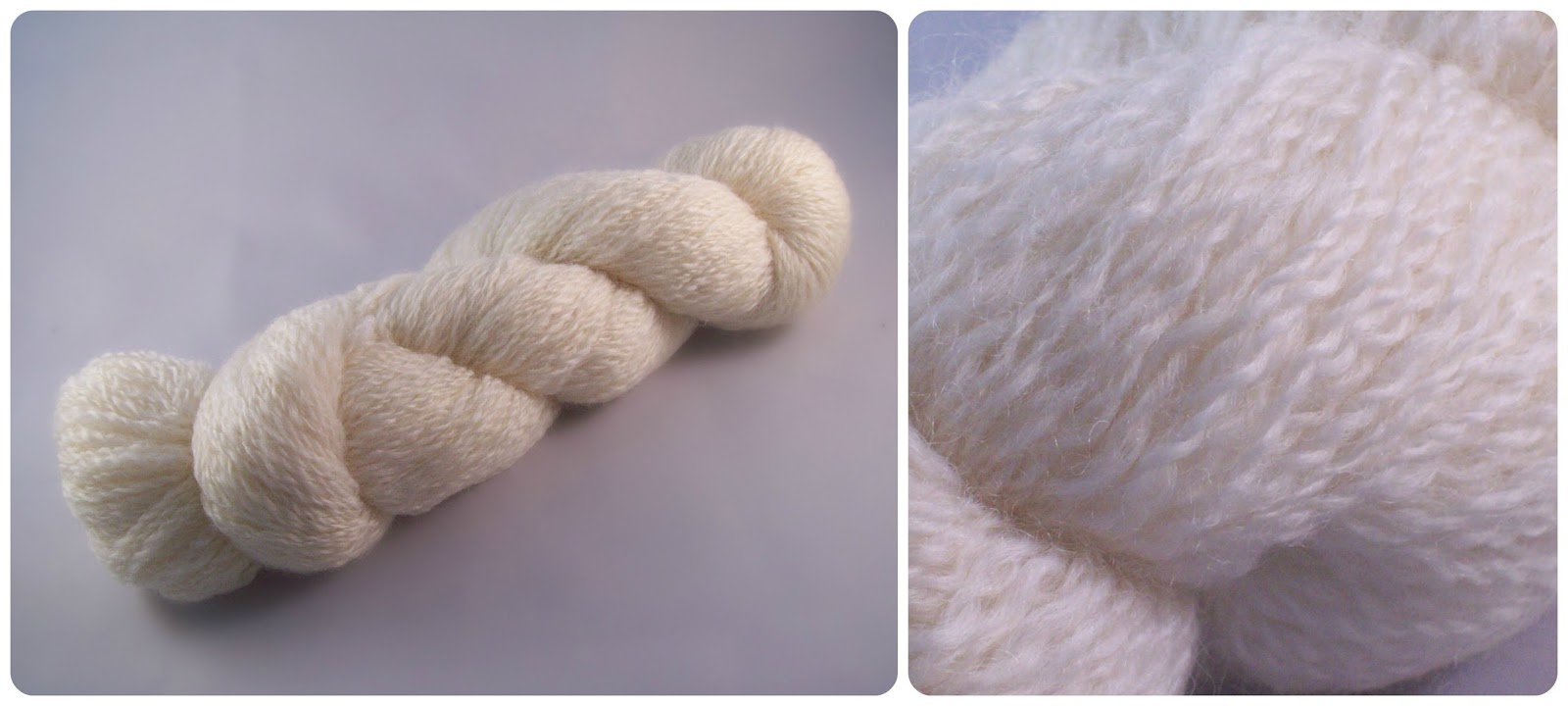
I finished spinning this fleece on 5th March and I got 9 skeins of yarn from this fleece, totalling 912g after their final baths which washed out any remaining dirt and lanolin.  Here is just one of those skeins in close up.


This will make a beautiful bridal shawl one day.


Thursday, 5 February 2015

Quilting Stitch Shawl - Design F310

I just had to make one of these fabulous eye-catching shawls.  Technically its not lace but there are eyelet lace stitches in the main body of the shawl and that is good enough for me.  Worked bottom up using two contrasting yarns and adding beads at the intersections of the quilt stitch section.  The yarn I used is Sirdar Denim Tweed Double Knitting in shades 501 (dark colour) and 623 (light colour), which is 60% acrylic, 25% cotton, 15% wool and I also used 312 size 6 glass beads in a rainbow raspberry colour.  I don't know what brand these beads are but they are not Toho.


I started knitting the ruffle at the bottom on 26th January and that was a boring laborious knit I can tell you.  It felt like it was never going to end as it took me two days just to knit that and a further 2 days to knit the two-colour beaded section.  Apologies for my ugly face being in the pictures, I took them late at night using the camera on my laptop.  The beaded quilted stitch section was quite puckered up/egg box looking during the knitting.

I finished knitting this on 3rd February, soaked and blocked it which really defined the beaded quilt stitch section.  I love the contrast in this design, so different to anything else.


Saturday, 17 January 2015

Blue Saturn Mohair Shawl - Design A2

I knew it wouldn't be long until I am back using more of the Colinette Yarns that I have in my yarn stash.  This time I have chosen a bright blue Mohair yarn in shade Blue Saturn and it is an Aran weight yarn in 78% Mohair, 13% Wool and 9% Nylon.

I chose a simplistic pattern due to the fuzziness of the Mohair and this pattern is adaptable to the amount of yarn that you have.  I cast on on 13th January and you work the basic pattern from the top down and then you decide how many rows of eyelet lace you want to work and if you want to split it up into sections of eyelet lace and plain and how many rows of each.  This way you can use up all of your yarn and make a bigger shawl or just work the minimum if you have a partial skein, its up to you.


It appeared slightly out of shape when it came off the needles on 14th January 2015 but as always a soak and block has rectified that.   A simple, quick yet elegant shawl to make.