Showing posts with label Greener shades dye. Show all posts

Monday, 2 October 2023

Dyeing an array of fibres purple

Further to my previous three posts I have continued to dye the Llandovery Whiteface Hill wool and fibre selection that I have chosen and now that the third lot is dry I can get on with my fourth and final lot. 

So, what I will be dyeing in each dye pot is:

150-155g of Llandovery Whiteface Hill wool that I hand combed myself
40g Suri Alpaca, this is some raw fleece from an alpaca called "Butterscotch"
25g of 14.5 micron Merino, which was from Day 23 of the 2021 Advent Calendar
25g of Mulberry Silk
12g of Tussah Silk Noil
12g of Trilobal Nylon
12g Milk Protein, which was from Day 19 of the 2021 Advent Calendar

I soaked all of the fibres in warm water with a splash of Synthropol added to the water to remove any "chemical finish" that may have been added to the fibres during production.  This also removes any grease and dirt that may be left in the fleece.

I made up a dye bath of 1% dye depth made up of 67.5% River Blue and 22.5% Flame Red and 10% Midnight Black.  What I weighed out was 1.86g of River Blue, 0.62g of Flame Red and 0.276g of Midnight Black.  The dye didn't take so well on the two Silk lots, they are little bit patchy but they are OK.


Friday, 29 September 2023

Dyeing an array of fibres blue

Further to my previous two posts I have continued to dye the Llandovery Whiteface Hill wool and fibre selection that I have chosen and now that the first two lots are dry I can get on with my third. 

So, what I will be dyeing in each dye pot is:

150-155g of Llandovery Whiteface Hill wool that I hand combed myself
40g Suri Alpaca, this is some raw fleece from an alpaca called "Butterscotch"
25g of 14.5 micron Merino, which was from Day 23 of the 2021 Advent Calendar
25g of Mulberry Silk
12g of Tussah Silk Noil
12g of Trilobal Nylon
12g Milk Protein, which was from Day 19 of the 2021 Advent Calendar

I soaked all of the fibres in warm water with a splash of Synthropol added to the water to remove any "chemical finish" that may have been added to the fibres during production.  This also removes any grease and dirt that may be left in the fleece.

I made up a dye bath of 1% dye depth made up of 75% River Blue and 25% Amazon Green.  What I weighed out was 2.07g of River Blue and 0.69g of Amazon Green.  The dye didn't take so well on the two Silk lots, they are little bit patchy but they are OK.


Saturday, 16 September 2023

Dyeing an array of fibres yellow-orange

Further to my post of earlier today I have also dyed a second batch of fibres the colour that I had intended to the first time around, before I weighed the dye out incorrectly.

So, what I will be dyeing in each dye pot is:

150-155g of Llandovery Whiteface Hill wool that I hand combed myself
40g Suri Alpaca, this is some raw fleece from an alpaca called "Butterscotch"
25g of 14.5 micron Merino, which was from Day 23 of the 2021 Advent Calendar
25g of Mulberry Silk
12g of Tussah Silk Noil
12g of Trilobal Nylon
12g Milk Protein, which was from Day 19 of the 2021 Advent Calendar

I soaked all of the fibres in warm water with a splash of Synthropol added to the water to remove any "chemical finish" that may have been added to the fibres during production.  This also removes any grease and dirt that may be left in the fleece.

I made up a dye bath of 1% dye depth made up of 95% Sunshine Yellow, 2.5% River Blue and 2.5% Flame Red.  What I weighed out was 2.62g of Sunshine Yellow and 0.138g each of River Blue and Flame Red.  The dye didn't take so well on the two Silk lots or the Milk Protein, they are little bit patchy but they are OK.


Dyeing an array of fibres orange-brown

Further to my post of a few days ago I have now decided what I am going to do with the combed Llandovery Whiteface Hill fibre.  I decided to split the fibre into 4 lots of around 155g each and add the same fibres to each lot but in different colours so that I can dye the fibre an appropriate colour and make 4 yarns that are almost identical but just in different colours.  The total amount of fibre in each lot will be enough to make 2 skeins of yarn and a nice amount to make a shawl.

I started out by sorting items from my ingredients cupboard into colour groups and then checking if I had at least 4 different colours of any given fibre.  Where I didn't have the necessary 4 colours that fibre was eliminated from the piles.  Next I had to decide which fibres in each colour group worked well together, such as which shades of blue out of all of the packets looked good together.  I ended up with 5 piles of 4 small packets of fibres so I had to eliminate one colour group, which I did easily as the colours didn't work together as well as the other piles.

I also decided that I would take the opportunity to dye some of the currently undyed fibres in my stash at the same time so that these would go into my "ingredients cupboard" for use at a later date.

So, what I will be dyeing in each dye pot is:

150-155g of Llandovery Whiteface Hill wool that I hand combed myself
40g Suri Alpaca, this is some raw fleece from an alpaca called "Butterscotch"
25g of 14.5 micron Merino, which was from Day 23 of the 2021 Advent Calendar
25g of Mulberry Silk
12g of Tussah Silk Noil
12g of Trilobal Nylon
12g Milk Protein, which was from Day 19 of the 2021 Advent Calendar

I soaked all of the fibres in warm water with a splash of Synthropol added to the water to remove any "chemical finish" that may have been added to the fibres during production.  This also removes any grease and dirt that may be left in the fleece.

I had intended my first batch to be dyed a kind of mustard yellow but I made a really stupid mistake when I was weighing the dye out and only realised once I added the fibres to the dye pot and saw the colour it all went.  Whoops, but a happy mistake because the fibres have turned out almost the exact colour I had intended for my second batch.

What I had planned was 1% dye depth made up of 95% Sunshine Yellow, 2.5% River Blue and 2.5% Flame Red.  What I should have weighed out was 2.62g of Sunshine Yellow and 0.138g each of River Blue and Flame Red.  What I actually weighed out was the correct amount of Sunshine Yellow and then I messed up and weighed out 1.38g each of River Blue and Flame Red (10 times too much of each colour).  The dye didn't take so well on the two Silk lots and in both cases they are kind of a peachy-coral colour along with what can only be described as grey and it looks like a pile of burnt rubbish. 


Friday, 9 June 2023

A day dyeing fibre - mostly wool

There is always a yellow fibre blend required for the TdF in commemoration of the Yellow Jersey.  I am not buying anything in especially this year but I have nothing true yellow in my vast stash either so I will need to get the dyes out and dye some fibres and then blend the results with others bits from my "ingredients cupboard".

Today is the day for doing this.  I also have a couple of other dye jobs I want to try and fit in today too.

Middle photo shows the dyed fibre drying.  Left hand side: before & after Celluose Fibre followed by the Merino/Suri Alpaca. Right hand side: before & after Mulberry Silk Noil followed by Trilobal Nylon

I weighed the fibre I intended to dye and made up a dye pot of Greener Shades Dye in Sunshine Yellow at a dye depth of 1%.  After all the fibre was soaked in warm water containing a dash of Synthropol I added the fibre to the dye pot.  There was a 100g of a white Merino/Suri Alpaca blend that I got from WoW a few years ago and that has really taken the dye well, very bright yellow.  5g of Mulberry Silk Noil that I've had a lot of years and interestingly that hasn't taken the dye as I expected but it is a pretty lemon yellow.  I also added 10g of an unknown cellulose or plant based fibre and I didn't really expect this to take much dye in, if any at all, as the dyes are specifically for wool and animal based fibres but it has taken some dye and is another one that has come out a lovely pale lemon.  The 5g of brilliant white Trilobal Nylon that I also added to the dye pot sucked in the dye really well and came out the same bright yellow as the Merino/Suri Alpaca.  I also tried throwing a small handful of hemp into the dye pot but that was totally unaffected by the dye so I haven't bothered to show that here.

My next dye job of the day is an idea that I had pop in my head whilst on holiday last summer.  I had an idea about what to do with the left over North Country Cheviot hand combed nests from the British Breeds project.  I want to split it into two and make two matching yarns in reverse colours but dye it in a very light, summery green with maybe natural whites, yellows and greens as complementary textures.

Middle photo shows the dyed fibre drying.  Left hand side: before & after Trilobal Nylon, Right hand side: before & after North Country Cheviot

After weighing and soaking the fibre I made up a dye pot of Greener Shades Dye at a dye depth of 0.2% made up of 75% Sunshine Yellow and 25% River Blue.  There was a 157g of hand combed North Country Cheviot, 6g of Trilobal Nylon and I also chucked in a couple of other fibres which were already dyed green but not quite the right shade, these were 18g of Merino in shade leaf and 7 of silk noil in shade Chorophyll but these didn't change colour, maybe a tiny bit, but not noticeably different so I haven't included the pictures here.

My final dye job of the day was to over-dye a variety of hot pink fibre that I would never use as it was and I also threw a few undyed bits of fibre into the dye pot as well just because I'm using another different colour. I made up a dye pot of Greener Shades Dye Coral Reef Aqua at a dye depth of 1% and threw all of the soaked fibres in and hoped for the best.  Some of the smaller amounts I used a large jar and scooped some of the dye water into it and stood it back in the pot just to keep the fibres from mixing with others.

In the first photo you can see a lump of pink bamboo on the right hand side, this didn't take up any dye at all so I will try dying that one again once I have the right dyes.

The colours of the fibres looked pretty good in the dye pot but when I checked the pH I discovered that I needed to make an adjustment to neutralise it but I think I might have messed it up a bit because it changed the colour of the fibre from evenly dyed to kind of a random patches of different colours.  I might not have needed to do anything and I am kind of regretting touching it.  I need to get a digital pH reader because I really struggle with those little paper things.

Top row: 59g Merino
Middle row: 10g Trilobal Nylon
Bottom row: 48g Merino - Baubles, Day 8 from Advent Calendar 2022

Top row: 25g Northern Lights Bliss (Merino)
Bottom row: 16 Tussah Silk Raspberry

The previously undyed fibre is below

4g Trilobal Nylon, 5g Tussah Silk Noil
4g Tussah Silk Noil, 5g Hemp

All I have to do now is wait for it all to dry and then make the blends I want with the yellow and the green and all of this purple and blue will go into my ingredients cupboard to use in future blends.

Saturday, 17 September 2022

Dyeing the Whitefaced Dartmoor for a second time

 A couple of weeks ago I tried to dye some combed Whitefaced Dartmoor wool using some left over cold water dye.  It didn't work.  At best it turned some of the outer-fibres of the hand combed nests a very very pale silver grey but it hadn't gotten down into the inner fibres. Today is the day that I am going to give this fibre some colour.

I am using my usual Greener Shades Dyes and have chosen to dye this at 0.5% dye depth (half a gram of dye per 100g of dry fibre), there is 282g of fibre and the dye is made up of 75% River Blue, 25% Amethyst Purple.

I did loosen the hand combed nests a bit before putting them in the dye pot in the hopes that the dye would reach all of the fibres and I am happy with the results.  The plan is to use this fibre in my own blend and add some other fibres and colours to it to make it more interesting and to add a bit of softness as well.


An interesting patchwork of blue and pink-y purple that I am sure will eventually make an interesting spun yarn and then go on to be made into something that someone would love to buy from me.

Sunday, 4 September 2022

A full day of dyeing stuff

I had quite a few things that I wanted to dye or over-dye so I set aside a full day to do as much as I could, time and available space to get it dry depending.

The first thing that I tackled was a shawl that I finished crocheting at the beginning of the year but was not happy because the yarn was darker in one part than the rest and this dark stripe ruined the shawl.  I had to buy dye specifically for this as my usual dyes don't work on cotton.  I have already blogged about the shawl and updated the post to show the finished dyed version and you can find that here.

I used a cold water Dylon dye in shade "Burlesque Red" and followed the instructions.  The water isn't properly cold, it has to be hand warm to begin with but doesn't require any further heat.  The shawl has come out pretty good though, I'm happy with it.


What I did do, whilst this shawl was having a nice soak, was to take a clean empty jam jar and scooped a small amount of dye water out of the dye pot and then pull off a 5g clump of undyed trilobal nylon from the 100g clump I have and pushed it into the dye water in the jar.  I made sure it was fully submerged and just left it on the side for about half an hour.  

The colour is nothing like the shawl, not even close, you would not think it was dyed using the exact same stuff at the exact same time.  It has come out a pale purple colour but evenly dyed though and this will now go into my "ingredients cupboard" for use to add a bit of shimmer when I make my own fibre blends.


The next thing that I dyed was some bright yellow cotton yarn that I would like to tone down a lot to make a more usable and appealing colour.

I have chosen the same cold water Dylon dye but this time in shade "Ocean Blue", fully aware that over-dying something yellow with blue will no doubt make it become green.

I'm happy enough with the result of the yarn, not ecstatic, but it's fine.  I also tried to dye some wool using the left over from the dye pot as it is supposed to be able to dye wool, just a much paler shade than you get from dyeing plant based fibres.  It didn't work, barely touched it, so I laid it to one side to dry until I could get around to using my usual wool dyes.


I done the same thing with this dye pot, I took a clean empty jam jar and scooped a small amount of dye water out of the dye pot and then pull off a 6g clump of undyed trilobal nylon and pushed it into the dye water in the jar.  I made sure it was fully submerged and just left it on the side for about half an hour.  

The colour is nothing like the yarn, but then I don't expect it to be given that I am dying something white with blue dye so of course it will be blue.  Again the result is evenly dyed and this will also now go into my "ingredients cupboard" for use to add a bit of shimmer when I make my own fibre blends.


The final thing that I wanted to dye today was the last of the white Jacob fleece that I have had a number of years, since 2014.  I had already chosen a dye and despite the poor results from trying to dye some Whitefaced Dartmoor wool in the left over blue dye I decided to still give it a go with the cold water Dylon dye in shade "Olive Green", given the fact that this is fresh unused dye and not left overs.  I have to say that it didn't work.  The results were poor and actually looked like it had been stained with urine.  Not nice at all.  However, the clump of trilobal nylon that I had dyed in the jam jar came out a lovely shade of very pale olive green.


So I now have two decent-ish amount of wool that is wet from a failed dye attempts.  The Whitefaced Dartmoor I am happy to allow to dry because its kind of a pale silver colour right now but the Jacob needs to over-dyed right now.  I dig out my wool dyes and shade book and I get to doing some complex maths and weighing out the dyes I need.  I chose a dye depth of 1%, that is 1g of dye for every 100g of dry fibre so its a good job I knew how much it weighed before I put it in the dye pot earlier, 427g.  I made the 4.27g of powdered dye up using 45% River Blue, 45% Sunshine Yellow and 10% Ruby Red and got cooking - the wool dyes require high temperatures.

I am happy with the results and can't wait to see what it will look like when it is combed and made to look nice and fluffy.


I also dyed some Trilobal Nylon with this dye by scooping some of the dye water into a jam jar with a small clump of the Trilobal Nylon pushed down into it.  This dye normally requires heat but I gave it a go with just it being stood on the side for about half an hour and it kind of worked.  Its not evenly dyed but it did take up some of the dye anyway so that's OK and I have some Trilobal Nylon from an old supplier that is just like this, not evenly dyed, and she gets away with selling it like that so I'm happy enough.


Friday, 16 April 2021

Mermaid - Badger Face Welsh Mountain - Torddu

Further to my post of 20th February about the Badger Face Welsh Mountain Sheep - Torddu, this post is about what I did with the "colourful" parts of the washed fleece and the small amount of hand combed fibre that I got from my purchase of just 50g of washed fleece.

The 50g of washed fleece

The 25g of combed top I got and then this top with the colourful parts from the other fleece

Obviously when I post about something that I've done, it is always after I have done it and sometimes I post in stages as I do it and other times I wait until I've completed the whole project and sometimes projects physically "cross-over" in real life, so whilst I'm waiting for something to dry I'm starting work on something else etc. In that post of 20th February I didn't mention that I had already dyed the colourful parts of the fibre when I had, in fact, dyed it on 18th February. I kept that information for this post.  I dyed it using Greener Shades Dyes in Coral Reef Aqua at a dye depth of 0.75%, so 3/4 of its usual strength, because I wanted a slightly lighter shade than usual.


I already had an idea what I wanted to do with it before I dyed it, which is partly why I dyed it that colour, plus the fact it was already slightly tinged blue from the raddle paint or whatever that the fleece had been marked with.  I wanted to make an oceanic yarn so I sorted out some ingredients in blue and green to add to it.

Top row: Colbalt Ramie, Gooseberry Merino, Peacock Angelina
Middle row: Caiprinha Trilobal Nylon, Torddu, Chlorophyll Silk Noil
Botton row: Ireland Silk Noil, Caiprinha Hemp, Harmony Merino

It was blended on 27th February and it looks really pretty like this.


It got left in a bag for a little while until I started spinning it on 16th April and I was having to thin out the small clumps of silk noil as I spun.


My finished yarn is a 2ply double knit weight and I have 112g/210m.  The final fibre count is 65.5% Badger Face Welsh Mountain Torddu, 27% Merino, 2.5% Ramie, 1.5% Trilobal Nylon (Firestar), 1.5% Silk Noil, 1% Hemp, 1% Angelina


Saturday, 28 November 2020

The Big Experiment - finally finished!

So I have finally gotten around to dying the skeins that I wanted to dye using blue dye.  I got out my favourite Greener Shades dyes to discover that I hadn't got enough of the River Blue by itself so I added a bit of Coral Reef Aqua into the mix too to make up the dye powder weight needed to dye this at 0.5% dye rate, which is using 50% of the dye you would use to get the standard colour strength for the dye.  I wanted it to be slightly lighter so that the colours of the merino might stand out a bit more rather than potentially be obliterated by the dye.

The colourful Merino have not reacted with the blue dye like I expect it to but its still made an interesting yarn.

The oddments blend has taken the dye well and looks quite similar to the other 3 skeins, its just that the fibre content is very different.


The mini skein of just Jacob wool has produced an interesting variegated yarn too.


Tuesday, 28 August 2018

The Custom Order is Finished

So I've finished my first custom order for a bride and she is very happy with it.  I can now send this off to the USA and hope that it does actually match her wedding colours when its in the flesh as it were.


Tuesday, 21 August 2018

My first custom order for a bride

I am so excited by this but it is also really nerve wracking.  I've been asked if I can recreate one of the shawls in my shop, pictured below, but in a golden yellow colour for her wedding in October. 

I do have some yarn in the right thickness and the exact colour that she wants but I don't have enough so I looked to buy more online only to discover that they don't make this colour anymore and I can't find any of that shade available to buy online nor can I find an alternative yarn to use either that is the same colour, the same thickness and around the right price to fit within her budget.  Drat!  OK, let's have a go at dying some of my own hand spun white that would be perfect for the job and fits the budget.

Voila!  Think I've hit the mark pretty good looking at the colour swatch she sent me, and that is with me mixing the Greener Shades dyes to achieve just the right shade, keeping in mind that the chemicals in the water and the wool itself can alter the final shade.  The customer is happy and has placed the order.  I now have to make this quickly as it has to go all the way to the USA for mid-September as she needs it for the final fitting etc.


Monday, 16 July 2018

Dyeing the Llanwenog fleece

Further to my post a few days ago about buying and washing the Llanwenog fleece.  After it was washed and dried it weighed 1332g, down from the 1714g dirty fleece weight.  I've decided to split this into 4 parts. 

When I talk about dye depth percentages, this is the weight relationship between dry fleece and dye powder so a 1% dye depth, the standard colour depth, is 1g of dye for every 100g of dry fleece.  To achieve a dark shade you use more dye, such as a 2% dye depth and to get a lighter shade you use less dye.

I was using Greener Shades Dyes, which are my favourite dyes that I have used so far. 

I took 400g of fleece, which was the blue stained part of the fleece plus some of the white fleece, and dyed this blue using Coral Reef Aqua at a dye depth of 0.5% to achieve a lighter shade than normal but still dark enough to cover up the staining. 

The rust colour I made up at a dye depth of 0.5% using three different colours of dye: 50% Flame Red, 25% Amethyst Purple, 25% Sunset Orange.  I used 400g of white fleece on that.

The pale green was achieved using a dye depth of just 0.2%, made up of two colours of dye: 75% River Blue, 25% Sunshine Yellow and this was on 270g of white fleece.

The remaining 262g of white fleece has been left undyed.


I definitely love the blue and the green.  The rust colour was a bit of a surprise as I had to substitute one of the dyes that I should have used, as called for in the "recipe book" for another slightly different colour as I had run out of one of the colours so I wasn't sure what it was going to turn out like.


Monday, 16 April 2018

Working on a Romney fleece

I need to be quicker at processing fleece and spinning it up because I actually bought this fleece back in August 2012 and I am only now working on it 5 1/2 years later.  That's a crazy amount of time to have a fleece and not do anything with it.

Romney, which used to be called Romney Marsh Sheep is a long-wool breed of sheep originating in Kent and is often referred to locally as a "Kent". 

When this arrived all those years ago it was rolled up and took me some time to figure out how to open it out.  It had lots of sheep marker on it in different colours.  I'm not sure if this was spray marker used for marking sheep that are pregnant/how many lambs they're having or whether some of this was from the raddle that is strapped to a Rams chest and marks the Ewe during mating.

Its a Ewe fleece and weighed 3.4kg before skirting and washing.  After washing it weighed 2.175kg.  I'm not sure if its because it's been stored for so long or whether its just me being so much more experienced and picky about the fleece that I am prepared to put the effort in make into yarn but this is far more coarser than I recall.  This is another fleece where I ended up binning most of it and only keeping the best fibres from the fleece so from the 2.175kg that was waiting to be combed, I only actually have 362g of hand-combed top for spinning.


By the end of sorting out all that fleece and only coming away with such a small amount of swag I was quite disappointed and fed up with the whole thing so I spun it up very quickly and quite thick to get it out of my sight as quick as possible.  Three skeins of Aran weight yarn that I forgot to take photos of as this point.

I tried dyeing the yarn with the natural liquid dye kept from the boiled up carrot tops from last year and using the appropriate mordant it should have dyed the yarn green but it didn't work, it smelt rancid and stunk the house out.  I had to open doors and windows to try to vent the house and I also used one of the wax melts that I had for Christmas to make the house smell nice again.  I can't find anything anywhere about how long natural dyes from plant material will store for other than the statement "store until ready to use", but clearly 10 months is too long and I would imagine it needs to be used within about a month of making it.

I had to rinse the yarn really well and over-dye it using my Greener Shades Dye and I chose Ruby Red.


I love the colour these have turned out.  These are all aran weight and I have re-measured them since taking the photos, which is why the discrepancy between the labels and what I've typed.  This one 128g/133m.


This one is 117g/121m


and this one is 106g/93m


Sunday, 18 December 2016

Portland Fleece - Part II

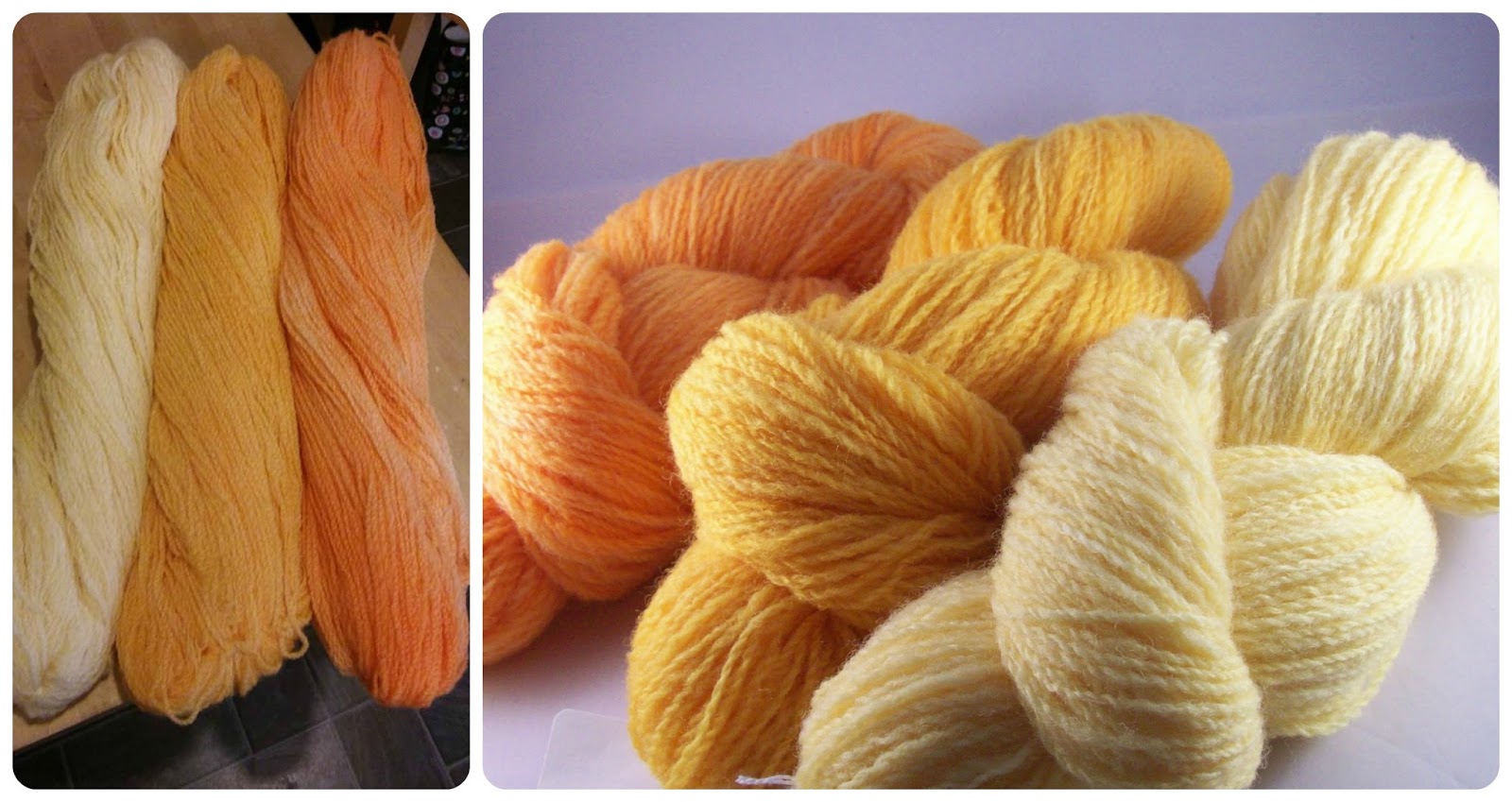
First up is one of the double knit weight yarns, which is 106g/328m.  I dyed this using Greener Shades dye at a dye depth of 1% in shade Sunshine Yellow.  A 1% dye depth means that you use 1g of dye for every 100g of yarn.


I had decided that I wanted to have a go at trying to obtain some peach yarns.  Peach can be a difficult colour to achieve, getting the tone right is a nightmare, never-mind trying to get three different shades.  I was using my micro scales to weigh out the tiny tiny amounts of dye needed in the percentages of each colour required and a milk bottle screw top cap was "the bowl" to weigh the dye into.

This first yarn is double knit weight and 105g/259m, dyed using Greener Shades dye at a dye depth of 0.1%, made up of 75% Sunshine Yellow and 25% Sunset Orange.  A dye depth of 0.1% means that you use 0.1g of dye for every 100g of yarn and then this total amount of dye is split 75/25 between 2 colours.  Can you imagine weighing out 0.075g of dye and 0.025g of dye to make up that one-tenth of a gram of dye required!

This yarn is just as I had hoped for.


This yarn is double knit weight and 104g/274m, dyed using Greener Shades dyes at a dye dept of 0.2%, 75% Sunshine Yellow, 25% Sunset Orange.  Technically this is just a dark shade of the first yarn.  The colours and percentages used are exactly the same, its just the dye depth that is increased, which means that I use double the weight of dye for the same amount of yarn which produces as stronger/darker shade.   Not too bad, a tad orange, but maybe that was my dye weighing.  The micro scales that I have are not the best as a really really good accurate set cost a lot of money, which I hope one day I will be able to afford to get.


The final yarn is worsted weight and 105g/255m and again dyed with Greener Shades dye at a dye depth of 0.2% made up of 75% Sunset Orange and 25% Ruby Red.  With hindsight I am thinking that instead of shifting dye colours and introducing Ruby Red that perhaps I should have just doubled the amounts of dye used on the previous 2 skeins again to make a 0.4% dye depth or even calculated for a 0.3% dye depth.  


 And finally a pretty photo to show all 3 colours off together. It's just a pity that I didn't use all three double knit weight yarns for this dye experiment, I could have used them together in one project if I had done that.


Monday, 25 April 2016

Alpaca Shawl - Design S207

I decided to make another shawl the same as the black and red Shetland wool shawl but this time using my own hand spun Alpaca.  This skein is 131g/288m of sport weight 100% Alpaca yarn and you can read about how I spun it here, its the very last skein at the bottom of the blog post.


I cast on on 20th April and finished on 25th April 2016.  It was rolling up on itself pretty bad.

I soaked it and pinned it out on my blocking boards and as it began to dry I noticed something that I didn't like, a definite line of change of colour right along the centre of the lace and then again, another shift in colour a little further up, right in the centre above the lace, just as I started the short row knitting.  There is nothing wrong with a variation of colour in a skein of natural coloured yarn, no animal is one exact shade of colour throughout, even human hair is more than one shade of colour naturally but it was more to do with the severity and placement of the colour shift. If the shift in colour had been very close to the point where the lace joins the main body of the shawl I would have been happy as that would have looked deliberate.  I decided that I didn't like it and would dye the finished shawl.  I dyed it using Greener Shades Dye, choosing the most natural colour that I could find in the recipe book and hoped for the best that it would at least hide the colour shift.


I think it turned out alright, it could have all gone terribly wrong, not only the dye job but the whole thing could have turned to felt during the dyeing process.  I think it looks like a natural colour of Alpaca, I've spun some this colour before.


Thursday, 29 October 2015

Can you over-dye black fleece or yarn?

I have spun loads of natural "black" yarn and just how black that yarn is depends on all sorts of factors including; breed of sheep, genetic strain of breed, amount of sunlight the fleece has been subjected to, general weathering and probably a whole host of other factors can contribute to just how black a black sheep is.

I was looking at all my skeins of handspun black yarn together and the variation in shade from chocolate brown to almost jet black and was wondering if it was possible to over-dye something this dark, having already had success with dyeing mixed coloured fleeces.  I asked around on various forums that I visit and, to be honest, not many people responded and out of those only one or two had even tried.  Hmmm, ok, its up to me to just give it a go then!

I took the two black skeins from Hillcrescent Farm Jacob Fleece No.4 and the black skein from Hillcrescent Farm Jacob Fleece No.6 to have a go at making them a little more interesting.

I started out overdyeing the No.6 black with Greener Shades dye in Amethyst Purple at 1% dye strength but this turned out to not be strong enough and so I dyed it again at the same level of dye, effectively making it a 2% dye strength, and whilst not perfectly even coloured, the result isn't too bad and you can see the difference between undyed and dyed in the top two photos.


I then took the worsted weight yarn from Fleece No.4 and over-dyed that with Greener Shades dye in River Blue at a dye strength of 2% and got an all over even toned shade.


Lastly, I took the double knit weight yarn from Fleece No.4 and over-dyed that using Greener Shades dye Ruby Red, again at a 2% dye strength, for a lovely dark red yarn.


So, yes, you can over-dye something that is dark in colour as long as you use a strong dark colour at a decent dye strength.  Its no good tickling it with a weak dye as you may as well throw that dye down the drain.  I think that it has made these yarns a lot more interesting and prettied them up.

Yes, yes, I know I messed up with this last photo as they're not in the same order, I'm only human.