Showing posts with label Lincoln Longwool. Show all posts

Sunday, 21 September 2025

Polwarth - Australia

Polwarths are named after the county in southwest Victoria, Australia, where the breed was developed by Richard Dennis of Tarndwarncoort in 1880, whose father and uncles had emigrated to Australia from England. Originally, he called them "Dennis Comebacks". They are common in Australia and New Zealand and have made their way to South America, but they are known as "Ideals" there. They are also common in The Falkland Islands. Polwarths were developed by breeding Merino rams to Merino/Lincoln Longwool crossbred ewes in order to improve meat production whilst at the same time maintaining a high-quality fleece. This means that they are one-quarter Lincoln Longwool and three-quarters Merino. The Polwarth Sheepbreeder's Association of Australia was formed in 1918, and the studbook was closed in 1948; the breed is now classified as a conservation breed. Most of the Polwarths in Australia are now in the higher-rainfall regions of Southeastern Australia, where pastures have improved.

They are a medium-sized, predominantly polled breed of sheep (some do have horns) with rams weighing 66kg-80kg and ewes weighing 50kg-60kg. The fleeces weigh 4.1kg-5.9kg are even and soft and a pleasure to work with no matter how they come to you; as raw wool, clean fibre or yarn. They are really fine at 21-26 microns, due to the Merino input, but also longer, due to the Lincoln Longwool input, with staple lengths of 3-7 inches (7.5cm-18cm). The locks are dense with rectangular staples with flat or slightly pointed tips and well-defined crimp. Polwarth fibres fluff up immediately with washing, which has to be done with care if you don't want felt. They are mostly white but can be silver grey through to black and tan through to dark brown.


They produce beautiful and soft next-to-skin fibres. The white fleece takes dye really well, natural colours can be overdyed for interesting results. This breed is perfect for baby garments, due to its softness, but also has good drape, so lace shawls are good to make with this. It also has elasticity, resilience, and loft, so it will make quite bouncy yarns.

As with all fine wools, hot water is required to effectively remove the grease from the fleece of the Polwarth and do not let the water cool too much else the grease will be redeposited onto the fleece and will then be really problematical to remove. Spin from the lock, flick or comb. Combing is the best way to prepare this fleece. Carding can be done on the shorter fibres. Spritzing with water as you comb will control the static. Do not try to spin this fibre with freshly applied greasy hand cream, it will not like that. Make sure anything applied to your skin is well absorbed into the skin before you start work on this fleece. 

I brought this breed in as 100g of prepared fibre ready to spin in December 2020. I have processed some beautiful Polwarth from fleece in the past and you can find that post here and what I made from that yarn here.


This was a lovely spin, starting on 19th August and spun two singles, plying them on 21st August 2025.  It is one of the more naturally white of the white wools, many others lean heavily towards pale cream, but this breed is quite white.


I spun this as fine as I could, knowing that it would bounce up during the washing and setting the twist process.  It turned out as a 14wpi yarn of 98g/443m.

I didn't knit the project piece until 19th and 20th September 2025, only using about 9g of the yarn.


This one is easy to read the lettering.

Sunday, 11 July 2021

Lincoln Longwool Sheep

The Lincoln Longwool breed of sheep has been around since at least the 13th century and was improved during the 18th century by using some of Robert Bakewells improved Leicesters (which had themselves been improved using the Lincoln and so carried some Lincoln genes).  Originally they were tall sheep with a long, coarse fleece but they were thin and did not provide good meat and so by improving them with the improved Leicesters introduced the genetics for a heavier carcass and more meat whilst also not diluting the Lincoln genetics too much.


The Lincoln Longwool sheep, at the time of writing, is in the Rare Breeds Survival Trust category 3: Vulnerable (500-900) registered breeding ewes and they are mostly in Yorkshire and Humberside but are also popular with smallholders.  Once very popular due to the sheer volume and lustrousness of the fleece during the late 19th century and early 20th century by the 1950's numbers fell sharply and by the 1970's the breed was on the brink of extinction following the introduction and popularity of the new oil-derived fibres such as acrylic.  Thankfully there were three very dedicated and determined breeders that go by the names of Watts, Bird and Read who maintained their bloodlines and kept the breed alive.  By 1990 there were over 100 registered flocks, still nowhere near the 350 flocks of 1900, but better than it had been.  Today, the breeding numbers have dropped once again and with the majority of those left being located in Lincolnshire, should there be another outbreak of Foot and Mouth Disease the breed is extremely vulnerable to extinction.

They are the largest of the British breeds and produce the heaviest, longest and most lustrous fleece of any breed worldwide.  Despite their huge side, with ewes weighing in at 91kg-113kg and rams being 110kg-160kg, they are extremely docile.  Both sexes are polled.   They have white faces, dark ears, a wide forelock of wool and the legs are white and woolly

They produce a huge size fleece of generally 5.4kg-9.1kg that has very long locks of around 7-15 inches (18-38cm).  The locks are distinct, firm and heavy with pointed and often spiralled tips and defined crimp.  Most of the fleece are white but some coloured fleece do exist and they tend to be multi-shaded, not a solid overall colour.  The fibres are generally up in the 40 something microns, beautiful and lustrous but definitely not soft and cuddly.

This fleece can be spun from teased locks, it can be picked, flicked or combed using Viking combs.  The length and coarseness of the fibres does not make it a candidate for carding.  Spin smoothly and keep hands far apart for drafting to occur.  Takes dye well due to the lustre.  I have prepared and dyed an amount of Lincoln Longwool before and I dyed it in three colours, here, here and here.

Yarns spun from Lincoln Longwool fleece are definitely not for next-to-skin items and are best suited to household items and upholstery and not for any kind of clothing except maybe a lined jacket.  They make hard-wearing, sturdy beautiful fabrics.


I have bought this breed in as 100g of pre-prepared fibre.


I forgot to take any spin-in-progress photos so I only have the finished skein.


My finished yarn is of crisp and sturdy to the touch of the hand and you can feel the prickly hair but the lustre, ooohhhhhhh, the lustre!.  I have 99g/135m of sport weight yarn, so quite dense compared to some of my yarns in this weight but this is a Longwool breed and my years of experience told me that this would be a dense type yarn, all Longwool spins are! My knitted piece for the project only 57g/78m so I have some left to do whatever with.


Tour de France/Tour de Fleece 2021 Stage 15

The Cycling: Stage 15 is 191.3km long and starts in Céret and ends in Andorra-la-Vella. Today's route takes the riders outside of France and into Andorra today and contained an 18.4km long uncategorised climb right from the start as well as containing one category 2 climbs and 3 category 1 climbs.  Sepp Kuss won the stage.  

Team Challenge: "Have you been a bit of a stationary spinner with the same view or location each day?  The Tour de France cyclists have a different view every mile, so let's change things up a bit!

Your challenge today is to spin in a different location and take a picture to show us where today's chosen seat is!".

What I planned to do and what I achieved:  Well, I didn't sit anywhere different to spin but I have spun 100g of pre-prepared Lincoln Longwool that I bought from World of Wool.  I have 133m of sport weight yarn for my British Breeds Project and that is another 399m for the team total.

We have been having fun on the social media chat for the team and one of the other team members posted this, which I find hilarious!

"Sheep, sometime in winter (probably on a misty day), transform into clouds on legs, a whole different creature.  They change back just after shearing takes place, so technically sheep's wool is cloud wool.  Unless you're spinning a long wool sheep, when its possibly easier to say they're not sheep, but mysterious mop creatures".

It made me laugh out loud especially given that I have spun up a long wool breed today, Lincoln Longwool, and I have somehow managed to schedule myself Whitefaced Woodland followed by Devon & Cornwall Longwool, followed by Teeswater.  What was I thinking, 4 long wool breeds one after the other with just the Whitefaced Woodland getting in there to break up the run, although that can be quite longs itself.


100g/133m of Lincoln Longwool


Thursday, 11 August 2016

Lincoln Longwool - Softly Solid Jade

I brought this from The Fibre Fairy back in October 2012.  I bought 4 different large braids from her and this is only the second lot that I have spun up so far.  My other one to date was the green Polwarth wool.  The Fibre Fairy appears to have closed down the business, which is probably why I got so many bargains.

Being so happy with the result of my spinning and dying of the Lincoln Longwool lamb's fleece I decided to try this Lincoln Longwool in shade "softly solid jade".  There is 345g of fibre here, that is a big braid of combed fibre.


I started spinning this way back on 9th June and I separated it out into 3 fairly even amounts and then each of those amounts into two as I spun up each little bag, and its taken until 9th August to finish spinning it all.  It was quite compacted and hard work to spin, made a lot easier by pulling it apart as best as I could to loosen all the fibres out.  I made 3 skeins of 2-ply yarn.  Its not as nice as the Lincoln Longwool that I dyed and spun myself from raw fleece and doesn't have anywhere near the same amount of lustre, which it should have if enough care had been taken during the dying process, which judging by the lack of lustre and how it has compacted I would guess has not happened in this case.


All three skeins have come out as sport weight yarn and are 107g/269m, 111g/263m and 107g/258m and will be used together to make one large shawl.

Sunday, 28 February 2016

Lincoln Longwool Lamb Part III - Purple

Following on from my last post about this fleece, this is the third and final part of the same lamb's fleece that I purchased back in July 2014.

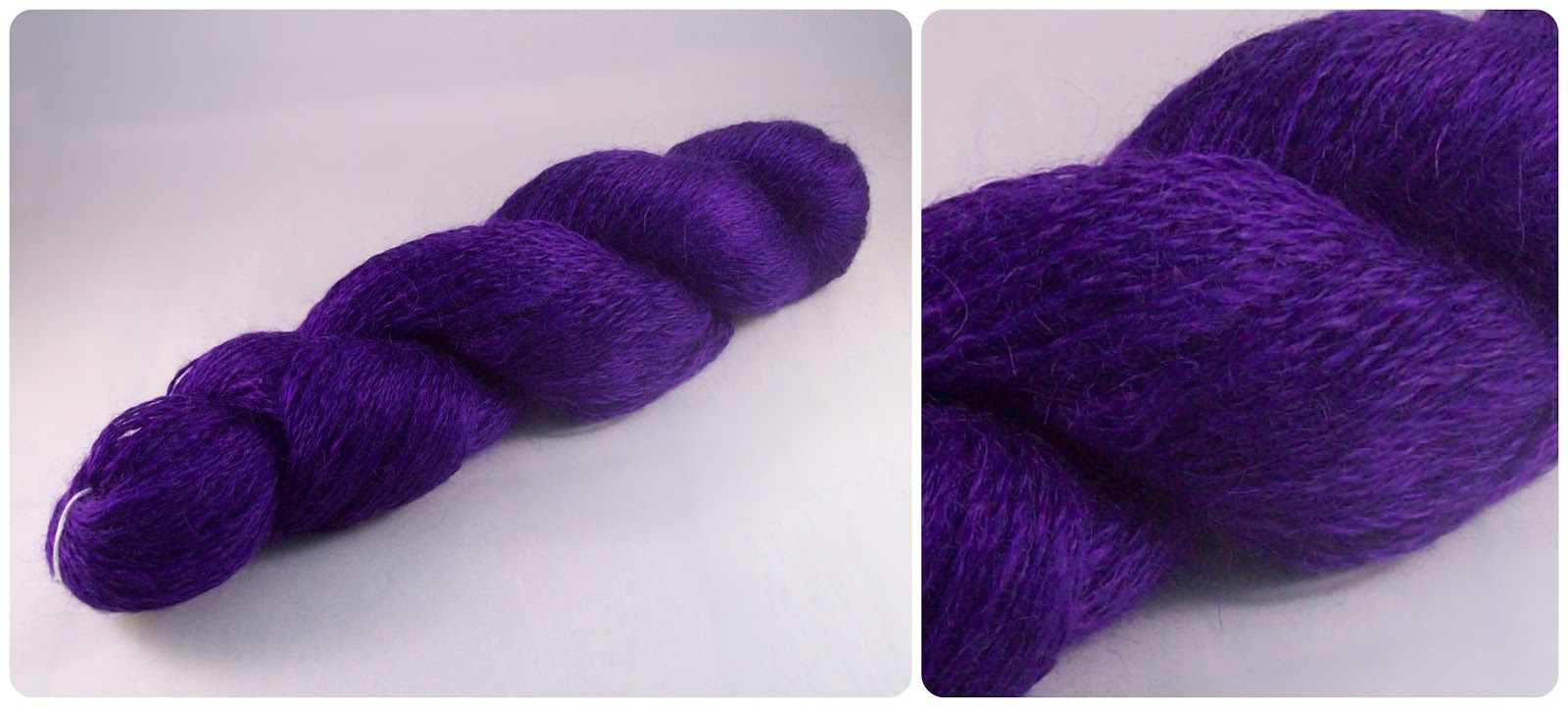
I dyed this part of the fleece a really rich purple, very similar to Cadbury's purple, using Colour Craft All in One Easyfix dye in Purple.  I started out with 208g of dyed locks and after combing in was left with 129g of hand-combed nests ready to be spun, a yield of around 62%.


The camera flash has not helped with colour reproduction in the first photo, which shows the locks of dyed fleece drying after being dyed.  The middle photo shows some of the hand-combed nests and the final photo shows one of the "singles" on a bobbin after being spun containing approximately half of the spun nests.

This produced a Light Fingering weight yarn, 125g/432m that has strong rich colour and a fantastic lustre.


So that is all 3 different colours lots of the fleece, dyed and spun.  I was inspired to dye them these particular colours by something that I have had for many years and that is a tea-light lantern that I believe I purchased from Boots the Chemist more than 15 years ago, that has 3 different colours of glass panels, the colours are repeated around the back too.


Thursday, 7 January 2016

Lincoln Longwool Lamb Part II - Deep Violet

This is the second lot of dyed fleece from the same Lincoln Longwool Lamb's fleece.  This was the fleece that arrived in "unusual" packaging and was really damp and smelly.

This second lot, I dyed using Colour Craft All In One Easyfix dye in Deep Violet.  I started out with 207g of fleece and after I had combed this I was left with about 127g of nests to be spun, a yield of around 61%, less than the maroon but I did manage to felt a bit of the fleece so that had to be binned.

I took the photo of the dyed locks using the flash but this has severely distorted the colour.  The bottom photo is more true to colour.  I completely forgot to take photos of the fleece being combed or of the nests ready for spinning.


This made a Light Fingering yarn, 127g/396m that has wonderful lustre and depth of colour.


There is just one more lot of this fleece in another colour.  I can't wait!

Friday, 16 October 2015

Lincoln Longwool Lamb Part I - Maroon

I bought 1kg of Lincoln Longwool Lambs fleece in July 2014 from a guy in Sleaford, Lincs, who was selling quite a few of these fleece.

It arrived in "unusual" packaging, it was inside a cereal box which was wrapped in paper.  The packaging was dry on the outside but the fleece felt really damp and the locks felt heavy.  When it first arrived it was really filthy and after taking photographs of the fleece, I weighed it at 1kg and the put the fleece into a carrier bag and left it in our laundry room, leaving the bag open for the air to get to it and dry it out.  I weighed it again about 24 hours later and it had lost 100g in weight and smelt musty but was now quite dry, as you would expect it to have arrived.


I sorted through it and threw away 112g of rubbish and then washed it as soon as my hanging drier was available - it was summer and I take advantage of washing/drying/dyeing fleece whilst its dry and warm and so its almost in constant use.  I was left with 621g of clean fleece after washing and drying it.


This fleece was then stored for a while until, on 10th April 2015, I split the fleece into 3 equal parts and dyed each lot a different colour; maroon, deep violet and purple.

The first lot, I dyed using Colour Craft All In One Easyfix dye in Maroon.  I started out with 206g of fleece and after I had combed this I was left with about 150g of nests to be spun, a yield of almost 73%


This made a Light Fingering yarn, 140g/480m that has wonderful lustre.


There are two more lots of this fleece in other colours and I can't wait to get my hands on them.