Showing posts with label British Breeds Project. Show all posts

Sunday, 21 August 2022

Putting the British Breeds Project together

I have finally finished the British Breeds Project that I have been working on for the best part of 2 years.  I created the knitted charts back in December 2020 using an old Cross Stitch Design programme that I had and that thankfully still worked on updated operating systems.  Each breed had it's own stitch chart that I printed out onto A4 paper and worked from when knitting and using the programme I was also able to move and rotate each individual breed design into a format that would show how it would all fit together.  It took quite a bit of time to get this right as I wanted the coloured fleece evenly distributed and balanced throughout the overall design as best as I could and in one or two cases I had to re-work the breeds name to fit the available space within the overall design, because some of the names are quite long so can fit on one, two or three lines.  This might sound confusing, but when you look at the design layout below it should become clearer.  I also wanted the names radiating outwards from a central descriptive panel, which is why some of them are upside down, and I also left a bit of room between each piece for the joining together, which I knew I would be doing by some kind of crochet method.


So, I spent from December 2020 to around about November 2021 locating pre-prepared fibres for spinning and fleece for preparing and spinning and spinning it all up and knitting the pieces.  As the number of knitted pieces built up I started pinning them together as per the overall design shown above.  By 8th November 2021 I had reached the point where I was just missing the fleece of one particular breed and everything else was knitted up and pinned to each other but I was already aware that there may be a problem with the actual layout of the pieces as a couple of them had knitted up so much bigger and others knitted up a bit smaller.  I decided that there was no point doing anything with regard to re-designing the layout until I had the final breed, which I finally got in June 2022.  

This was how it was looking pinned together as per the first design with a few pieces still missing


I spent most of July participating in the Tour de Fleece 2022 and then I had a weeks holiday.  Once back from holiday I knitted up the piece and spent the next couple of weeks washing and blocking all of the individual pieces and measuring the actual physical size of each one and then re-drawing each one on the Cross Stitch programme but all the wording got messed up doing this so I decided that I no longer needed the stitched text in each box and so just use typed text to identify what each piece is.  Typed text cannot be rotated, which is why it is all facing one way in the design below, despite the fact that it is also broken up and it is clear the some of the boxes will be sideways on in real life.  This new design, whilst not true to size, does at least show the true size correlation between each of the pieces.  I also left larger gaps for the crochet joins, with each row/column of squares on the graph representing one row of crochet.


My crochet joins were started by working 5ch, 1sc, 5ch, 1sc all the way around each piece with the 1sc being spaced at 2cm intervals and however many rows were needed, keeping in mind that there is at least one row needs around each knitted piece and the row that joins the two together, so if there is 5 graph squares between knitted pieces that is two rows around each piece and one row of loops to crochet the pieces together.  I started with the centre square, the description, and worked outwards from there, creating strips with small joins between each piece where needs be that fitted edge to edge, keeping it square/rectangular at every addition thus: Ryeland, North Country Cheviot, Description, South Country Cheviot were joined together to make a strip.  Devon and Cornwall Longwool was added onto the side of that, which kept it square.  Welsh Hill Speckled Face was added across the bottom of those, then Devon Closewool and Beulah Speckled Face were joined to each other and then that strip added to the rest and so on.  If you look at the design you can see how it would build up bit by bit and by doing the small joins between short edges first and then joining the long strips in one piece it makes for neater joins

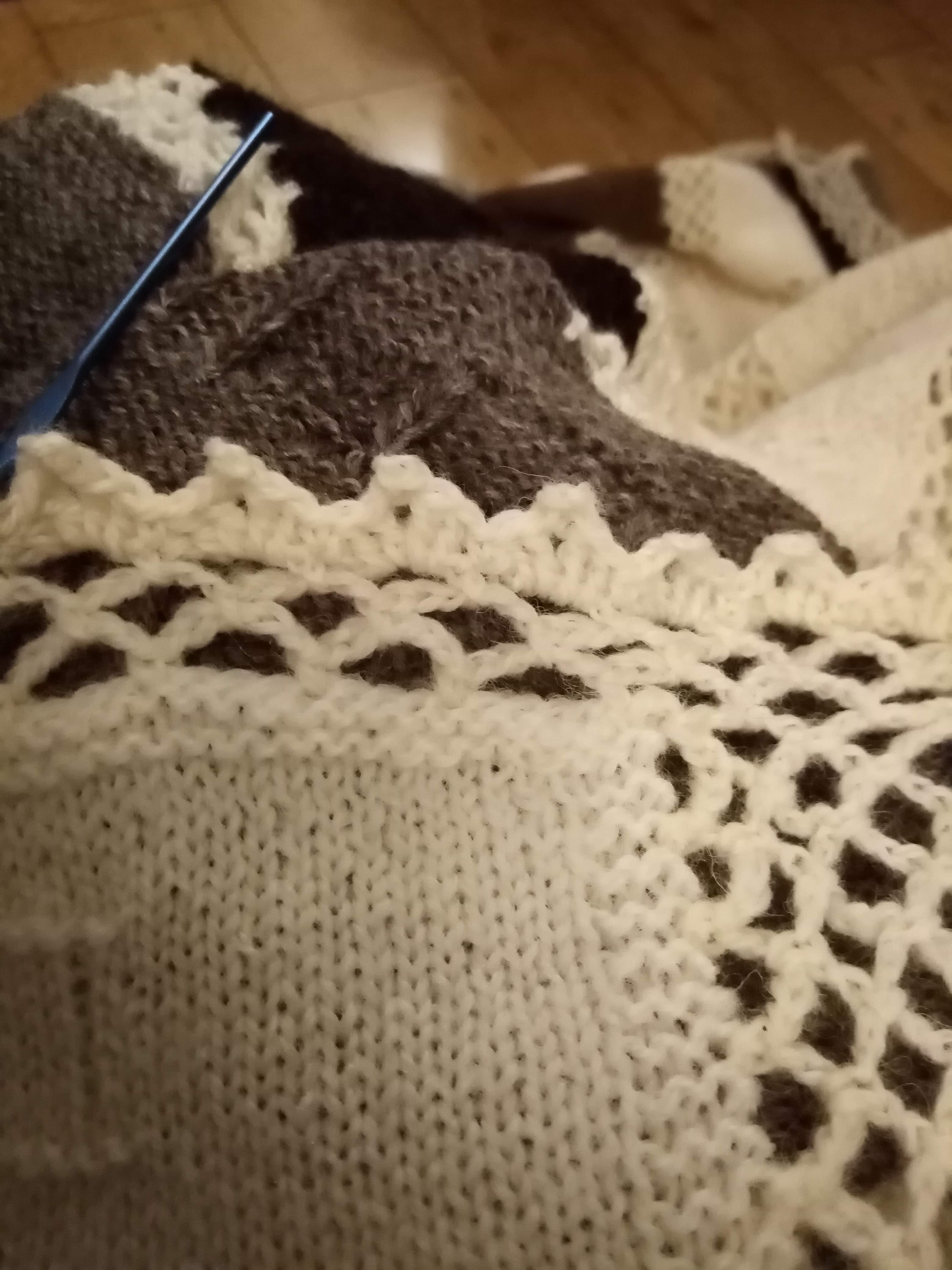
Close up of one of the joins

Starting to build up, the centre isn't in the centre right now but its all remaining square

I don't have anywhere large enough to get a full shot of it but it fits a King Size bed and hangs slightly over the side nicely


After laying it out on the bed once it was all joined together I realised that it needed a couple of rounds of crochet around the entire outer edge and maybe some kind of finishing edging to it, so I done the two rounds of chain and single crochet, increasing to from 5 to 7 chains on the 4 corners and then looked for an edging.  I found one and tried it out but whilst it went well with it it didn't quite fit, it had too many stitches and wouldn't lie flat so I adapted it and removed some of the stitches.

All my crochet instructions are the English terminology so my edging was: 2 treble into the chain space, 3ch, single crochet into the back of the first chain to make a picot, 2 treble into the same chain space, single crochet into the single crochet between chain spaces. Repeat in each chain space until the corner: 4 treble, 3ch, single crochet into the back of the first chain to make a picot, 4 treble into the same 7ch space, single crochet into the single crochet and then revert back to the regular 2 treble, picot, 2 treble pattern down the next edge.


It's all done and for the time being has been put into storage until the time that I can show it off somewhere at some distant time in the future.

Friday, 1 July 2022

Llandovery Whiteface Hill Sheep

The Llandovery Whiteface Hill sheep is a breed of Welsh Mountain sheep that has been bred for generations to thrive in the area of the Black Mountain in Carmarthenshire and is a little larger than other Welsh Mountain sheep.  Development of the breed has focused on retaining the hardiness and maternal quality of the breed whilst improving conformation to ensure that demand for ewes for breeding stock and lambs for the food chain and the focus remains on improvements for the meat market.  There is no focus on improving the fleece.  Demand for breeding ewes come from all across Wales and beyond for the production of Welsh Mules and Welsh Half-breds. The Llandovery Whiteface Hill Sheep Society was founded in 1998 by a small number of local farmers wanting to progress the genetic development of the breed.  However, they do not appear to have a website as yet.


Llandovery Whiteface Hill ewes

Llandovery Whiteface Hill rams

The Llandovery Whiteface Hill sheep, at the time of writing, is in the Rare Breeds Survival Trust category 6: "Other UK Native Breeds" (over 3000) registered breeding ewes.  Breeders remain in the localised area of Llandovery and the sheep are sold at Llandovery Market.  There is no information about this breed in either of my two reference books and one of them is produced by the British Wool Marketing Board, who couldn't tell me anything about the breed when I approached them for information and if it wasn't for the fact that this breed is listed on the Rare Breeds Survival Trust website I would not have known that it even existed.  There is also very little information on the Internet about the breed either and nothing about the qualities of the fleece, micron counts, weight or staple length or how best to prepare it.  It seems that it is undiscovered from a hand spinning point of view.

They are a medium build sheep with a whiteface and legs, which are free from wool, white ears and black nostrils. Ewes are naturally polled but rams can be with or without horns.

They produce a medium size dense white fleece, mine arrived at a little over 3kg, that contains a large amount of kemp in both white and red.  The staple length is around 4-5 inches (10-12.5cm)

The advise in my reference books for similar fleece is that they can be spun from teased locks, it can be carded or combed. If you leave the kemp in that it is going to create a very textured scratchy yarn with interest from the red kemp.  If you comb it and remove the kemp then you will be left with lovely soft wool.

Yarns spun from Llandovery Whiteface Hill fleece that contain the kemp are definitely suited to household items and upholstery and if you have removed the kemp then I would say that they are definitely good for next-to-skin use.  


This one has been extremely difficult to get my hands on and it has taken me over a year to obtain a fleece. I couldn't find any for sale anywhere because it is not well known and I discovered that the British Wool Marketing Board just clump the fleece in with other white Welsh Mountain fleece.   Given that there is no website for the breed society there was no obvious point of contact.  I did find a blog post that mentioned the breed and I contacted that person, who was very helpful and put me in touch with a farmer of the breed who informed me that his sheep were sheared the previous week, on 16th June 2021, and he was happy to sell a fleece to me.  Then it went silent and I never heard from him again.  I feared it might have been due to Covid but it wasn't and I eventually gave up on him.

I recommenced my search in April of this year, just before the start of shearing season, and the best time to make contact with breeders to reserve a fleece.  Seeing as how the Rare Breeds Survival Trust know about how many of this breed there are I contacted them for help and they gave me an e-mail address for the breed society.  I made contact but never got a response.  Browsing Instagram one day I suddenly got the idea to search for Llandovery and lots of business accounts came up, one of which was a wool shop in the town, so I made contact.  I got a response the following day to say she couldn't help but she put me in touch with someone else.  That person couldn't help me either but she gave me a phone number to call so I rang the number and it was the Llandovery Market, where they sell the sheep.  I explained to them what I was doing and that it was the last fleece I needed to complete the project.  They gave me a name and a phone number of a local farmer who, in their words, is very approachable and helpful.  I rang and left a message and after a couple of chats on the phone I purchased a fleece and it arrived quite quickly.

I have bought this breed in as a full fleece from Wyn Morgan in the Brecon Beacons and it arrived on 8th June, my 20th wedding anniversary, and it weighed just over 3kg.  I had a little peek inside the top of the bag and it looked very kempy but I wasn't able to get it out of the bag and examine it until I had time to start washing it on the 10th June.


About half of the fleece was washed on 10th June and it filled my drying hanger so the rest had to wait until this was dry.  This first batch filled a pillowcase and weighed 1,105g (excluding the weight of the pillowcase.  The rest of the fleece was washed on 14th June and weighed 811g once it was dry, giving me a total of 1,916g of clean but kemp rich fleece to prepare.


I combed 228g of fleece to get 94g of gorgeous, soft, hand combed top, just enough for my project.
  

Look at how white and fluffy that single looks on the bobbin


My finished yarn is of good quality to the touch of the hand it is really soft and squishy and light with just a very tiny crispness to it if you squeeze it hard. I have 93g/230m of double knit weight yarn. My knitted piece for the project took 46g/114m so I have some left to do whatever with, and the rest of the fleece of course.


Friday, 7 January 2022

Combing and spinning the white Jacob fleece

I don't need to blog about this breed because I have already done that when I wrote about the Black Jacob back in December 2020

I decided to use white Jacob to join all of the individually knit project pieces together.  I also have a decent amount of Jacob fleece in my stash and therefore at my disposal.

I decided to use the white parts from two different Jacob Fleece that were from the same flock of sheep and that I acquired way back in 2014 from a farmer friend of an ex-colleague and friend.  These were from Fleece No.2 and Fleece No.16, the same as I used for the grey centre piece of the project.


From Fleece No.2 there was 700g of washed fleece and this gave me 446g of fluff after combing.  From Fleece No.16 there was 460g of washed fleece and this gave me 285g after combing.  Each lot was in a different clear bag and I noticed that there was a very noticeable difference in the shade of white/cream between the two.  Well they are from different sheep and no two are exactly the same. Imagine it just like with humans, how many shades of natural blonde hair are there? Quite a lot! I split the contents of each bag into 7 equal weights and put one lot from each bag together on my blending hackle to even out the shade across all of the skeins that I will be making.

I didn't take any photos of the hand combed nests, whoops! I did take photos of the fleece before it was washed a few years ago though and I have those to show comparison between the two.

I did spin it all up into 7 skeins that weigh between 92g and 98g each and are double knit weight.


My finished yarn is of medium quality to the touch of the hand and is so much nicer than the black Jacob sample.  In total there is 658g/1433m of double knit weight yarn.