Monday, 23 May 2016

Small garden, big change.

We live in a small mid-terraced house on a "walk" on the outer edge of a housing estate with a small front garden and slightly larger back garden with no direct vehicle access to the property.

Because the house is on a slight hill, the back garden is split into two levels and in the past, when the kids were little, we gated the lower section off for safety.  Now the kids are older and we have a small dog that gate has been removed and a small fence put up to stop the dog messing on the grass and killing it off.

We've had a change of neighbours on one side since we moved in years ago and to be honest they are not very pleasant to live next to in the slightest with regard to noise levels (in that it would be quieter to live above a nightclub), things being thrown over the fence, climbing up the fence to look over and just general intolerable behaviour that is not acceptable in normal society which makes it impossible to enjoy any time relaxing in the garden.  Our kids like to go out there in the summer, put up the little sun-protecting tent on the grass and make themselves a cosy reading/colouring nook with blankets and pillows etc, but not anymore due to the unpleasantness, so we gave them the option of leaving it as it is in the hopes things may improve or for us to turn the garden into a working garden where we can grow vegetables and maybe get a few chickens.  They both enthusiastically voted for growing vegetables and getting some chickens.

Here goes...
 The first photo was taken a few years ago, its the only one I have that shows how the garden was before.  We had to hire the grass cutter thing and it was hard work getting the grass up.
Then we removed the small pond, which had been neglected since the neighbours threw an egg over last year which hit the fence, smashed and the contents went into the pond on a hot sunny day and wrecked the water pump.  In its place we put the Railway sleepers for the base of the chicken house and I had to move my Jasmine.  The ground underneath the grass contains a lot of clay and is difficult to dig so we also built a large raised bed and started filling it with the contents of the two huge compost bins.
We put weed control sheet down and will get some shredded bark to put down as path.  We had to get a number of big bags of compost to fill the top of the raised border.  Yeah, that's me sifting through the homemade compost.  We also chose some vegetables to grow and this year we will try runner beans, purple cauliflower, savoy cabbage, small round carrots and we bought a small pot of rainbow beetroot.  We also have a small tomato greenhouse and we have cherry tomato, yellow cherry tomato and a lemon hot chilli pepper.  We also have herbs in containers of lemon balm, mint, curry plant and lemon thyme.

The chicken house is on order and we've found where we will get the chickens from but will wait until after our holiday to go and get the chickens.

Monday, 25 April 2016

Alpaca Shawl - Design S207

I decided to make another shawl the same as the black and red Shetland wool shawl but this time using my own hand spun Alpaca.  This skein is 131g/288m of sport weight 100% Alpaca yarn and you can read about how I spun it here, its the very last skein at the bottom of the blog post.


I cast on on 20th April and finished on 25th April 2016.  It was rolling up on itself pretty bad.

I soaked it and pinned it out on my blocking boards and as it began to dry I noticed something that I didn't like, a definite line of change of colour right along the centre of the lace and then again, another shift in colour a little further up, right in the centre above the lace, just as I started the short row knitting.  There is nothing wrong with a variation of colour in a skein of natural coloured yarn, no animal is one exact shade of colour throughout, even human hair is more than one shade of colour naturally but it was more to do with the severity and placement of the colour shift. If the shift in colour had been very close to the point where the lace joins the main body of the shawl I would have been happy as that would have looked deliberate.  I decided that I didn't like it and would dye the finished shawl.  I dyed it using Greener Shades Dye, choosing the most natural colour that I could find in the recipe book and hoped for the best that it would at least hide the colour shift.


I think it turned out alright, it could have all gone terribly wrong, not only the dye job but the whole thing could have turned to felt during the dyeing process.  I think it looks like a natural colour of Alpaca, I've spun some this colour before.


Thursday, 21 April 2016

Pretty in Turquoise - Design LF433

I loved making that last shawl so much that I just have to make another one right now.  What colour though?   Oooh I have so many colours in all kinds of amounts but the main deciding factor is the main colour, the one that joins all the flowers together because you need 8 full reels of Goldfingering for that and with all but 7 colours now discontinued that makes it a little trickier.

What I did was to sort out what colours, other than gold or silver, that I have at least 8 full reels of or the equivalent of 8 full reels of and put these in little bundles and then looked at what colours were left and what would work with those main colours.  I have been able to sort out the colours for 6 more of these wonderful shawls in a good range of colour combinations.

I chose to use navy blue, white and turquoise for my next shawl.  The turquoise is the oldest thread, then the navy and the white is a new reel.  You can tell this by the way that it is wound onto the reel.


Initially I was unsure whether to use white for the centre with blue petals or blue for the centre with white petals but then nature provided the answer for me in the name of Anemone Coronaria.  Such a strikingly beautiful flower.


I started making this on 6th April and finished it on 19th April 2016.  Of course, with the thread being 80% viscose, 20% metallised polyester, the sun really does catch it wonderfully and makes it sparkle.  I hope the photo below in the top right of the group of four shows this off.


I love turquoise, it belongs to one of my favourite colour groups which are green-blues and blue-purples.


Monday, 4 April 2016

Pretty in Lilac - Design LF433

I like to vary the craft that I do so I switched to crochet again.  Choosing both a design and thread from the 1970's, both by Twillley's, I set to work on making a fringed motif shawl.  I chose three complimentary colours that I had in the right amounts from my vast "collection" of discontinued Twilley's Goldfingering Thread.  Twilley's do still make Goldfingering but only in a range of 7 standard colours; black, white, gold, pale gold, silver, bright red, forest green, which is a shame because I love Goldfingering, its so sparkly.  The fibre content is 80% viscose, 20% metallised polyester.

I chose to use silver, purple and lilac, with the silver and purple in this instance being the older two of the threads.


Silver for the centres, purple for the petals of the flowers and lilac to join them all together.


I started this on 28th March and finished it on 3rd April 2016.  The next two photos show the shawl before soaking and blocking and the results afterwards.  Don't worry, the fringing isn't clumped together in strips that is just how I laid it out for the photos.


Close up photos of the affects of a soak and block and how it really defines the pattern.


I really really love the finished shawl.  Ok, so its not soft and cuddly, its metallised polyester so it's not going to be, but at the same time its not so scratchy that you can't wear it either.  It is really sparkly, especially under good lighting or sunlight and that fringing has such a good sway to it.  I have to make more of these in other colours, it would be rude not to!


Sunday, 27 March 2016

Black and Red Shetland Shawl - Design S207

I've chosen a skein of my own handspun for my next shawl.  I made this yarn about 3 years ago, you can read about it here.

I decided to make a simple scarf type shawl with a lace border in sport weight of 87% Shetland Wool, 13% Cotton.


I started on March 22nd and was done by March 25th 2016 and used all but about 20m of the yarn.  This design has you knit the border first and then knit to the middle and work short rows back and forth, knitting across extra stitches every time until you have knit across them all.  A simple row of eyelet lace for the top and and cast off.


As you can see in the photos below, blocking really made the lace border and the shaped edging stand out.


I always struggle to take good, clear, details pictures of the darker items, especially black or nearly black.  Its lovely, soft and warm.


Thursday, 24 March 2016

Passionate Beaded Lace - Design L323

I have been wanting to use this yarn for a long time but was in two minds about using it to make something for my shop following the very big public outcry about how some producers in China keep their Angora rabbits in tiny wire cages, stacked on top of each other so that the rabbit cannot run around, the wire cuts into their feet and food and excrement drop onto them from cages above them.  When they harvest the fleece they literally rip the hair from the rabbit, causing severe pain and making it bleed.

Whilst this may be true of some producers, lets face it there are immoral rogue traders in every industry that only focus on profit and don't give a damn about welfare of people, animals or the environment, this is not true of all producers.

Being a Pagan, a lover of animals and the environment I am mindful of where I source all of my materials.  I want the best quality that I can get but I also want materials that are produced in a way that does not harm animals or the environment.

I bought this yarn, and a couple of other colours in the same yarn, from a lady in the UK that looked after her Angora bunnies like they were her children.  They had huge pens in which they could run around, inside pens for bad weather and night time and outside pens for daytime and good weather and they got to feel the grass under their feet and get some sunshine.  Unfortunately, since I bought my yarn her health took a bad turn and she has a debilitating painful chronic illness that is not curable but is manageable but she no longer produces yarn.  I know that her family were helping with the bunnies, making sure that their numbers did not increase but making sure that they were happy and well cared for.

Angora bunnies coats are constantly growing and moulting, like a cat or a dog's coat does and it requires regular brushing to prevent matting.  They were handled daily and their coats get brushed carefully whilst they sat on her lap nibbling at carrots.  She then removed what had been collected in the brush and this is what she spun and dyed once she had  collected enough of it.

The yarn is 100% Angora rabbit in laceweight, each skein being 50g/400m and the colours is "Passionate" which is a blue-purple with pink streaks.  I decided to have another go at making the shawl that took me two years to make and challenged myself not to take that long this time!  I picked beads to represent the colours in the yarn as best as I could, blue with a touch of pink, and so they are Size 8 Toho round seed beads in shade 168: Trans-Rainbow Light Sapphire.


Starting on 16th November 2015 I used the same bead placement as last time, adding one to each of the diamond centres of the border and between the two rose leaves in the centre panel


I finished on 21st March 2016, used 248 beads and all but 5g of the yarn.  The photos really do not do the shawl justice as it is beautiful blue-purple, which is difficult to capture the exact colour.  It is so lightweight but warm too and floats like a dream.


Sunday, 28 February 2016

Lincoln Longwool Lamb Part III - Purple

Following on from my last post about this fleece, this is the third and final part of the same lamb's fleece that I purchased back in July 2014.

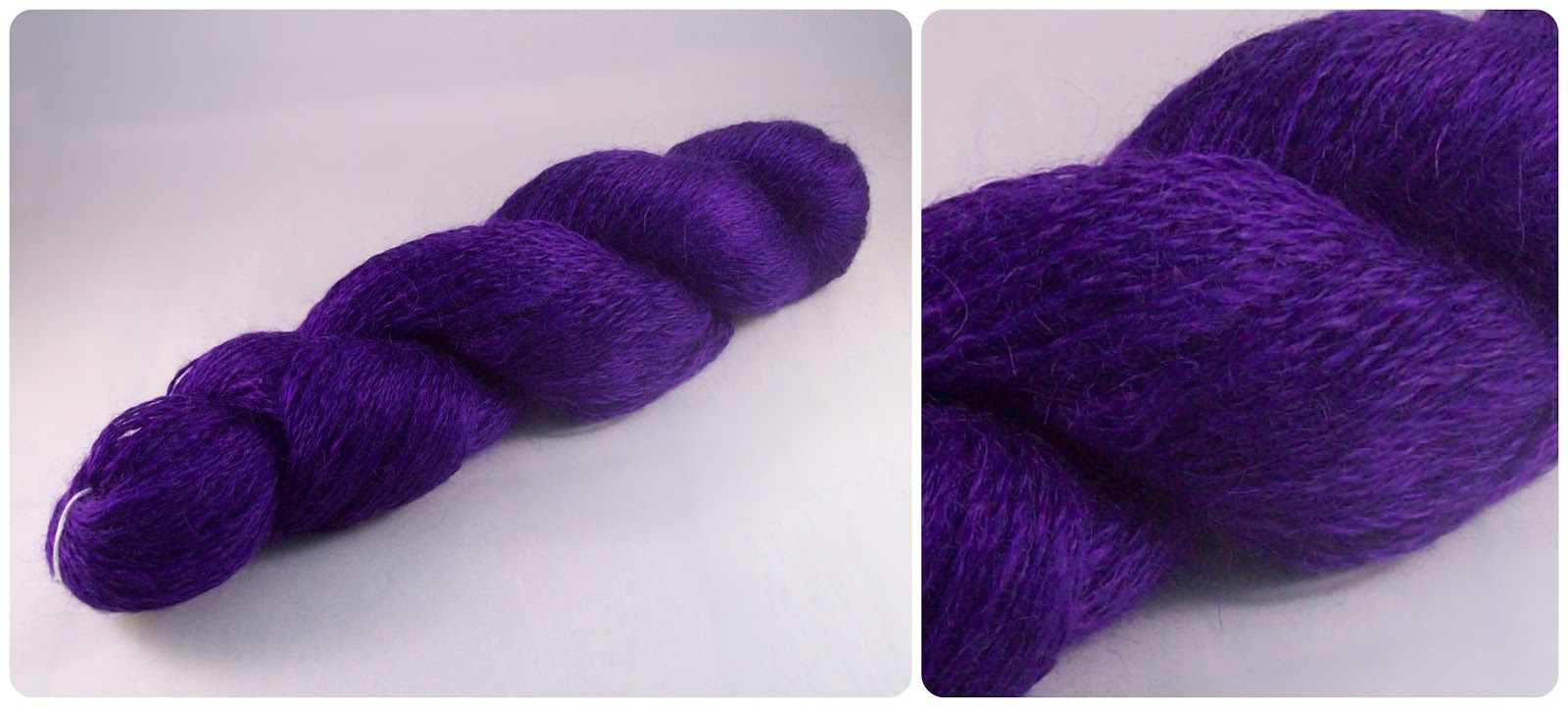
I dyed this part of the fleece a really rich purple, very similar to Cadbury's purple, using Colour Craft All in One Easyfix dye in Purple.  I started out with 208g of dyed locks and after combing in was left with 129g of hand-combed nests ready to be spun, a yield of around 62%.


The camera flash has not helped with colour reproduction in the first photo, which shows the locks of dyed fleece drying after being dyed.  The middle photo shows some of the hand-combed nests and the final photo shows one of the "singles" on a bobbin after being spun containing approximately half of the spun nests.

This produced a Light Fingering weight yarn, 125g/432m that has strong rich colour and a fantastic lustre.


So that is all 3 different colours lots of the fleece, dyed and spun.  I was inspired to dye them these particular colours by something that I have had for many years and that is a tea-light lantern that I believe I purchased from Boots the Chemist more than 15 years ago, that has 3 different colours of glass panels, the colours are repeated around the back too.