I really love these shawls and working with the bright colours of Twilley's Goldfingering. It might sound daft but working with Twilley's Goldfingering stirs lots of happy memories from my early childhood. My parents used this thread to make several "pin and thread pictures" that were so popular in the 60's and 70's. I know we definitely had one in the design of a London bus and another was a geometric design. I think there may have been one of an owl and one of a boat as well. If you have no idea what I am talking about, here a few images that I've pulled from the internet. People still make these and there are lots of modern designs around now as well.
Ok, shall we get back on track and bring my mind forward about 38 years to the present day?
For this shawl I decided on silver, medium blue and royal blue.
Actually, I started making the centres for this one immediately after making all the centres for the last one on that long train journey but I only managed half a dozen or so before we had to get off the train at our home station. This one then also got put to one side whilst I made all those Christmas baubles.
I got back to work on this after completing the bright green one, so that would have been the first week of January and I started working with the royal blue on 13th January. It really is a beautiful colour.
All done by 18th January 2017. The way that the motifs are joined to one another makes it look almost like a Moroccan tiled floor once it has been soaked and blocked.
Friday, 20 January 2017
Saturday, 14 January 2017
Zwartbles Fleece
One of the blackest black fleece sheep breeds is said to be the Zwartbles Sheep which originates from Holland and has been imported into countries around the world. I bought what was advertised as a "1kg of shearling lamb Zwartbles fleece" back in 2014 and, as always, it got skirted and washed on arrival and once dry it then gets put into an old pillowcase, the top tied and with a label and stored until I have time to process it. My 1kg of freshly shorn fleece became 690g of washed fleece.
A shearling lamb fleece, or shearling fleece, refers to a lamb born late in the season, maybe May/June time as opposed to most lambs being born January/February, that is not sheared in the year of its birth but sheared the following year as its too young to be sheared in the year of its birth. The main shearing season in the UK is May-July.
I know that this has been stored for 2 1/2 years but as I worked through this fleece I began to have serious doubts about the validity of this being a shearling lamb fleece. It is extremely coarse and wiry, more like a fleece that has come from an old sheep and not from a lamb at all.
I combed my way through the fleece, handfuls of locks going straight into the bin due to how coarse and wiry they were, the sun-bleached tips broke off as expected and my 690g of washed fleece became just 119g of hand-combed top for spinning and just 11.9% of the original weight of fleece that I purchased. Terrible, absolutely terrible and yet all I've heard about this breeds fleece is how nice it is, not as nice as Merino or Polwarth, but good reviews. I'm seriously disappointed with this one at the moment. I will try the breed again in the future but make sure I get it from another source.
At the end of everything I have 115g/395m of double knit weight yarn that is slightly crisp, not totally horrible, but its not cuddly soft either but will be a bit more hard wearing and less likely to pill than most other yarns.
Thursday, 5 January 2017
Pretty In Christmas Green - Design LF433
This shawl I started making way back at the end of August 2016, using the time spent on a long train journey, there and back, to crochet the centre of the flowers in gold, but only just finished making it on 2nd January 2017. I find that with the motion of travel I cannot knit but I can crochet quite happily.
It's another of the 1970's crochet motif design shawls made with Twilley's Goldfingering thread that is of varying ages, but all of it is 80% Viscose, 20% Metallised Polyester.
This I have chosen gold, forest green and emerald green.
Because I was making Christmas baubles for the past 3 or 4 months of last year I found that I didn't have much time to spend making this and so really only picked it up again once the baubles had been made.
The photos above show my bag of gold on a train, spread out on my lap being worked on and getting ready to trim that fringe straight. I have a laminated board just the right width to match the perfect length of the fringing so the knots get lined up along the top edge of the board and the fringe can be trimmed straight using the bottom edge of the board. In this photo I still have to push it upward to the top of the board.
The true colour is probably best represented by the photo of the shawl in the box that it will be delivered in.
Sunday, 18 December 2016
Portland Fleece - Part II
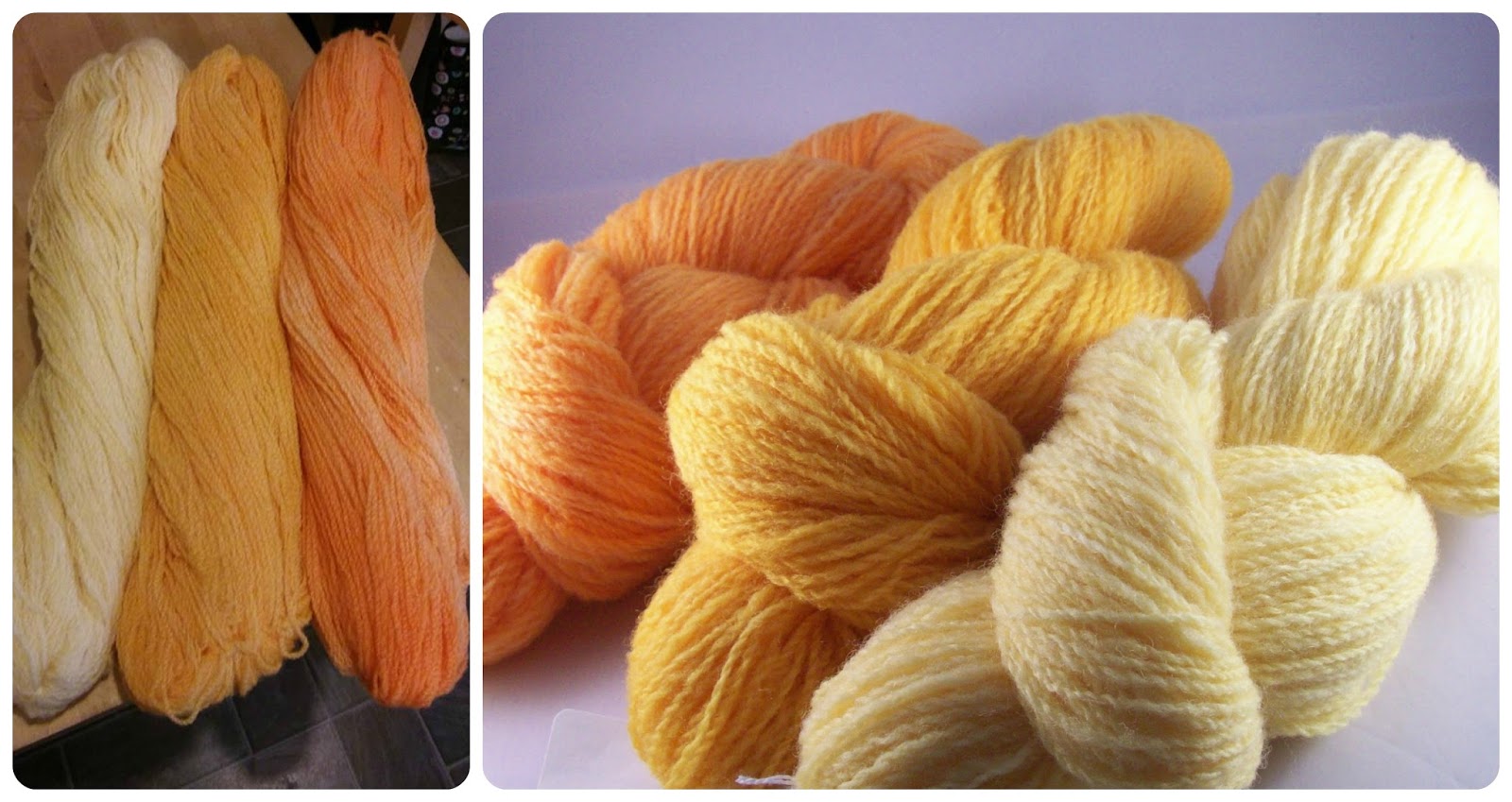
First up is one of the double knit weight yarns, which is 106g/328m. I dyed this using Greener Shades dye at a dye depth of 1% in shade Sunshine Yellow. A 1% dye depth means that you use 1g of dye for every 100g of yarn.
And finally a pretty photo to show all 3 colours off together. It's just a pity that I didn't use all three double knit weight yarns for this dye experiment, I could have used them together in one project if I had done that.
I had decided that I wanted to have a go at trying to obtain some peach yarns. Peach can be a difficult colour to achieve, getting the tone right is a nightmare, never-mind trying to get three different shades. I was using my micro scales to weigh out the tiny tiny amounts of dye needed in the percentages of each colour required and a milk bottle screw top cap was "the bowl" to weigh the dye into.
This first yarn is double knit weight and 105g/259m, dyed using Greener Shades dye at a dye depth of 0.1%, made up of 75% Sunshine Yellow and 25% Sunset Orange. A dye depth of 0.1% means that you use 0.1g of dye for every 100g of yarn and then this total amount of dye is split 75/25 between 2 colours. Can you imagine weighing out 0.075g of dye and 0.025g of dye to make up that one-tenth of a gram of dye required!
This yarn is just as I had hoped for.
This yarn is double knit weight and 104g/274m, dyed using Greener Shades dyes at a dye dept of 0.2%, 75% Sunshine Yellow, 25% Sunset Orange. Technically this is just a dark shade of the first yarn. The colours and percentages used are exactly the same, its just the dye depth that is increased, which means that I use double the weight of dye for the same amount of yarn which produces as stronger/darker shade. Not too bad, a tad orange, but maybe that was my dye weighing. The micro scales that I have are not the best as a really really good accurate set cost a lot of money, which I hope one day I will be able to afford to get.
The final yarn is worsted weight and 105g/255m and again dyed with Greener Shades dye at a dye depth of 0.2% made up of 75% Sunset Orange and 25% Ruby Red. With hindsight I am thinking that instead of shifting dye colours and introducing Ruby Red that perhaps I should have just doubled the amounts of dye used on the previous 2 skeins again to make a 0.4% dye depth or even calculated for a 0.3% dye depth.
Wednesday, 14 December 2016
Portland Fleece - Part I
I brought a kilo of Portland fleece online from Farnell Farm in Kent back in July 2014. Portland is one of the many breeds that are classed as a conservation breed where they were close to extinction but efforts have been made to dramatically increase numbers and save the breed.
They are a small breed and the fleece washes up to be a warm shade of white. There can be red kemp in the britch area of the fleece, and I did encounter some. Kemp is a very coarse hair like fibre that you really want to remove during the preparation process. The photo below shows a couple of locks, with a small amount of "seconds" attached, so called because it is the very short fibres produced when the shears go over a sheep a second time, shortening the fleece that is remaining on the sheep, and some will inevitably stick to the fleece as it is removed. These are easily removed by wool combs during the preparation for spinning.
The photo above, on the left, shows a clump of washed fleece with lots of red kemp in it and the photo above on the right shows a washed lock and an unwashed lock of fleece.
At the time of spinning the yarn my camera had broken and I didn't have a decent camera on my smart phone and so, unfortunately, there are no photos of the wool being combed, or of the combed nests or even of the spun un-dyed yarns.
I can tell you though that from my unwashed fleece weighed 1086g and after washing and removing a small amount of coarse fibre, including the red kemp, I was left with 675g of clean fleece ready to be prepared. After combing I was left with approximately 420g of nice, clean, soft fibre to spin. I spun 2-ply as usual and made 4 skeins of yarn, one in a worsted weight and 3 in double knit weights. I decided to dye the yarn and will cover this in Part II.
Wednesday, 30 November 2016
Baubles - November 2016
This will be the last and final post about baubles cos I don't know about you but I am getting a bit fed up of them now, despite how beautiful they are. These are all of those that I made in November.
![]() |
| 80mm black glitter baubles with vintage gold Twilley's Goldfingering |
![]() |
| 80mm black glitter baubles with vintage blue in 3 shade of Twilley's Goldfingering |
![]() |
| 80mm red matt baubles with vintage bright green Twilley's Goldfingering |
![]() |
| 80mm bright red shiny baubles with vintage pale gold Twilley's Goldfingering |
| 80mm dark red matt baubles with vintage pale gold Twilley's Goldfingering |
![]() |
| 80mm red glitter, shiny and matt baubles with vintage gold and silver Twilley's Goldfingering |
![]() |
| 80mm bright blue shiny baubles with white Twilley's Goldfingering |
![]() |
| 80mm blue matt baubles with vintage silver Twilley's Goldfingering |
![]() |
| 80mm pale blue matt and shiny baubles with vintage navy Twilley's Goldfingering |
![]() |
| 80mm champagne glitter, shiny and matt baubles with vintage brown Twilley's Goldfingering |
![]() |
| 80mm white glitter baubles with vintage silver Twilley's Goldfingering |
![]() |
| 80mm black glitter baubles with bold colours of vintage Twilley's Goldfingering |
![]() |
| 80mm black glitter baubles with vintage bright green Twilley's Goldfingering |
![]() |
| 80mm black glitter baubles with vintage silver Twilley's Goldfingering |
![]() |
| 80mm black glitter baubles with vintage 3 shades of pink Twilley's Goldfingering |
![]() |
| 80mm black glitter baubles with white Twilley's Goldfingering |
![]() |
| 80mm white matt baubles with vintage black Twilley's Goldfingering |
![]() |
| 80mm white shiny baubles with vintage bright red Twilley's Goldfingering |
Monday, 31 October 2016
Baubles - October 2016
I am enjoying making the baubles, seeing what colour combinations I can come up with. Other than the first two sets made way back when I was figuring out sizing and designs, no two sets are the same colour combinations and if there are then different designs have been used These are Octobers offerings with some unusual combinations just to be different to anything else out there.
![]() |
| 80mm silver shiny baubles with vintage purple Twilley's Goldfingering |
![]() |
| 80mm black glitter baubles with vintage purple Twilley's Goldfingering |
![]() |
| 80mm silver glitter, shiny and matt baubles with vintage pink Twilley's Goldfingering |
![]() |
| 80mm silver glitter, shiny and matt baubles with vintage pale blue Twilley's Goldfingering |
![]() |
| 80mm red shiny baubles with vintage gold Twilley's Goldfingering |
![]() |
| 80mm black glitter baubles with vintage lime Twilley's Goldfingering |
![]() |
| 80mm silver matt baubles with vintage blue Twilley's Goldfingering |
![]() |
| 80mm red glitter baubles with vintage black Twilley's Goldfingering |
![]() |
| 80mm black glitter baubles with vintage burgundy Twilley's Goldfingering |
![]() |
| 80mm denim blue matt and shiny baubles with vintage silver Twilley's Goldfingering |
![]() |
| 80mm black glitter baubles with vintage cerise pink Twilley's Goldfingering |
Subscribe to:
Posts (Atom)