I decided that I wanted to work through my vast yarn stash using up as many of the now discontinued yarns as I possibly could, starting with the thickest of the yarns, as I was running out of storage space for my yarn and this method would potentially free up the most space in the shortest amount of time.
I loved how Betty's shawl had turned out and I had only used about half of the white Rowan Romance that I had. I decided to make another one. I started knitting on 27th February and finished on 28th February 2014. I then soaked and blocked it.
This is a really dreamy shawl, its not a pure brilliant white but more of a soft warm white with a hint of glitter and is so soft and warm too. If I could still buy this yarn I would and I would make more of these shawls because I think they are perfect for weddings.
The lovely lady who went on to buy this shawl for her wedding very kindly sent me a photograph that I could use. She looks stunning.
Sunday, 2 March 2014
Thursday, 27 February 2014
Twilight Capelet - Design SB168 Small
I loved working with the Rowan Romance so much that I stayed with it for my next projects only this time I used some blue that I had in my yarn stash called Twilight and I decided to make the small capelet again that I had previously made using Colinette Point 5 in shade Morocco.
I wasn't entirely sure if I had enough yarn to make two of these but as it happens there was just enough to finish them both and both were made in one day, 25th February 2014.
Friday, 24 January 2014
Falkland Fibre
I've been shopping with Mandacrafts again and this time I have bought some lovely Falkland fibre. Now, confusing as this may seem there is not an actual breed of sheep called Falkland and the Island does not have its own native breed of sheep per se. The term "Falkland" is just a reference to where the wool comes from geographically. Most of the sheep on the Falkland Islands belong to one of a handful of breeds: Polwarth (a breed in its own right these days but originally 75% Merino and 25% Lincoln Longwool), pure breed Merino, Corridale and Romney and the fleeces are all of exceptional quality. There are no known sheep diseases on the Falkland Islands and so there is no need for chemical dipping. The fleece and fibre from the Falkland Islands is certified as organic.
I purchased 220g of combed top in colour way "Peaches and Cream", split into two equal parts and spun a single from each part. Plied together to make a sport weight yarn with a total of 623m.
Tuesday, 7 January 2014
A Wedding Shawl for Betty - Design B144
I was contacted by a relative in the U.S. to ask if I could possibly make a soft, white wedding shawl for her mother as her parents, Betty and John, were renewing their wedding vows after Betty was diagnosed with a terminal illness. I immediately set to work and was able to get it on its way to the U.S. within a couple of days. Inevitably it got caught up in the Christmas Post but it made it to its destination with a couple of days to spare before the ceremony.
I made the shawl using Rowan Romance in shade Glitter, a super bulky yarn of 36% acrylic, 27% nylon, 26% mohair and 8% polyester. The yarn is no longer manufactured, which is a shame because it was so lovely.
Betty was given the shawl on New Years day but was too ill to sit up and so she snuggled it like a blanket and was able to appreciate its softness and how beautiful it smelt, as I soak all of my shawls in a product called Soak.
The renewal of vows ceremony took place on 4th January at their home with all of their family around them and Betty passed away in the early hours of 5th January holding hands with her loving husband of more than 55 years, John.
I made the shawl using Rowan Romance in shade Glitter, a super bulky yarn of 36% acrylic, 27% nylon, 26% mohair and 8% polyester. The yarn is no longer manufactured, which is a shame because it was so lovely.
Betty was given the shawl on New Years day but was too ill to sit up and so she snuggled it like a blanket and was able to appreciate its softness and how beautiful it smelt, as I soak all of my shawls in a product called Soak.
The renewal of vows ceremony took place on 4th January at their home with all of their family around them and Betty passed away in the early hours of 5th January holding hands with her loving husband of more than 55 years, John.
Friday, 13 December 2013
Angelo - the Cotswold lamb - Part II
So, Angelo's fleece was 1950g when it arrived and after having the second cuts removed and being washed I am left with 1413g, which needs to be hand combed. Look at the lovely pillowcase full of gorgeous locks. Please see Part I for more info.
Now to the combs. With this fleece I made sure that I loaded the combs up with the cut end on the comb and the tip hanging down like it was on the sheep.
As you can see the tips are still a bit tight and a bit mucky but the combs should get these loosened and opened up. The photo on the right I think looks like Santa's beard.
Slowly turning locks into fluff...
We have fluff. Wow, look at the white fluff. Beautiful!
A hand-combed nest and a small sample of spinning. Not quite got it right but it was good to practice so I know how to adjust my spinning to this fleece and what I want to get from it.
Spinning the singles ready for plying and showing fineness with the UK 1 pence coin.
I plied the singles and skeined them up into just over 100g in each skein because they still looked a little dirty to me, something I really noticed just as I was about to wash the second batch of 3 skeins and so I lay one of the first 3 skeins, which was all nice and clean, in amongst the yarns waiting to be washed. As you can see from the photo on the left, there was a bit of a difference in colour. This is down to those tips still being a little stuck together and discoloured as I combed them but its all come out in the wash.
I got 10 skeins of yarn, all around the 100g or thereabouts mark and all in the sport weight range, all absolutely beautiful and soft with high lustre. The last photo shows them all lined up in number order, Skein 1 on the left, Skein 10 on the right.
These are going to make some fabulous wedding shawls, can't wait to get cracking on these but I have so many other things to do first.
Now to the combs. With this fleece I made sure that I loaded the combs up with the cut end on the comb and the tip hanging down like it was on the sheep.
As you can see the tips are still a bit tight and a bit mucky but the combs should get these loosened and opened up. The photo on the right I think looks like Santa's beard.
Slowly turning locks into fluff...
We have fluff. Wow, look at the white fluff. Beautiful!
A hand-combed nest and a small sample of spinning. Not quite got it right but it was good to practice so I know how to adjust my spinning to this fleece and what I want to get from it.
Spinning the singles ready for plying and showing fineness with the UK 1 pence coin.
I plied the singles and skeined them up into just over 100g in each skein because they still looked a little dirty to me, something I really noticed just as I was about to wash the second batch of 3 skeins and so I lay one of the first 3 skeins, which was all nice and clean, in amongst the yarns waiting to be washed. As you can see from the photo on the left, there was a bit of a difference in colour. This is down to those tips still being a little stuck together and discoloured as I combed them but its all come out in the wash.
I got 10 skeins of yarn, all around the 100g or thereabouts mark and all in the sport weight range, all absolutely beautiful and soft with high lustre. The last photo shows them all lined up in number order, Skein 1 on the left, Skein 10 on the right.
These are going to make some fabulous wedding shawls, can't wait to get cracking on these but I have so many other things to do first.
Monday, 4 November 2013
Hillcrescent Farm Jacob Fleece No.5
Further to my post a few months ago about buying a number of Jacob fleece from a local farm, I have selected one of the fleece at random to start preparing. This is Fleece No.5.
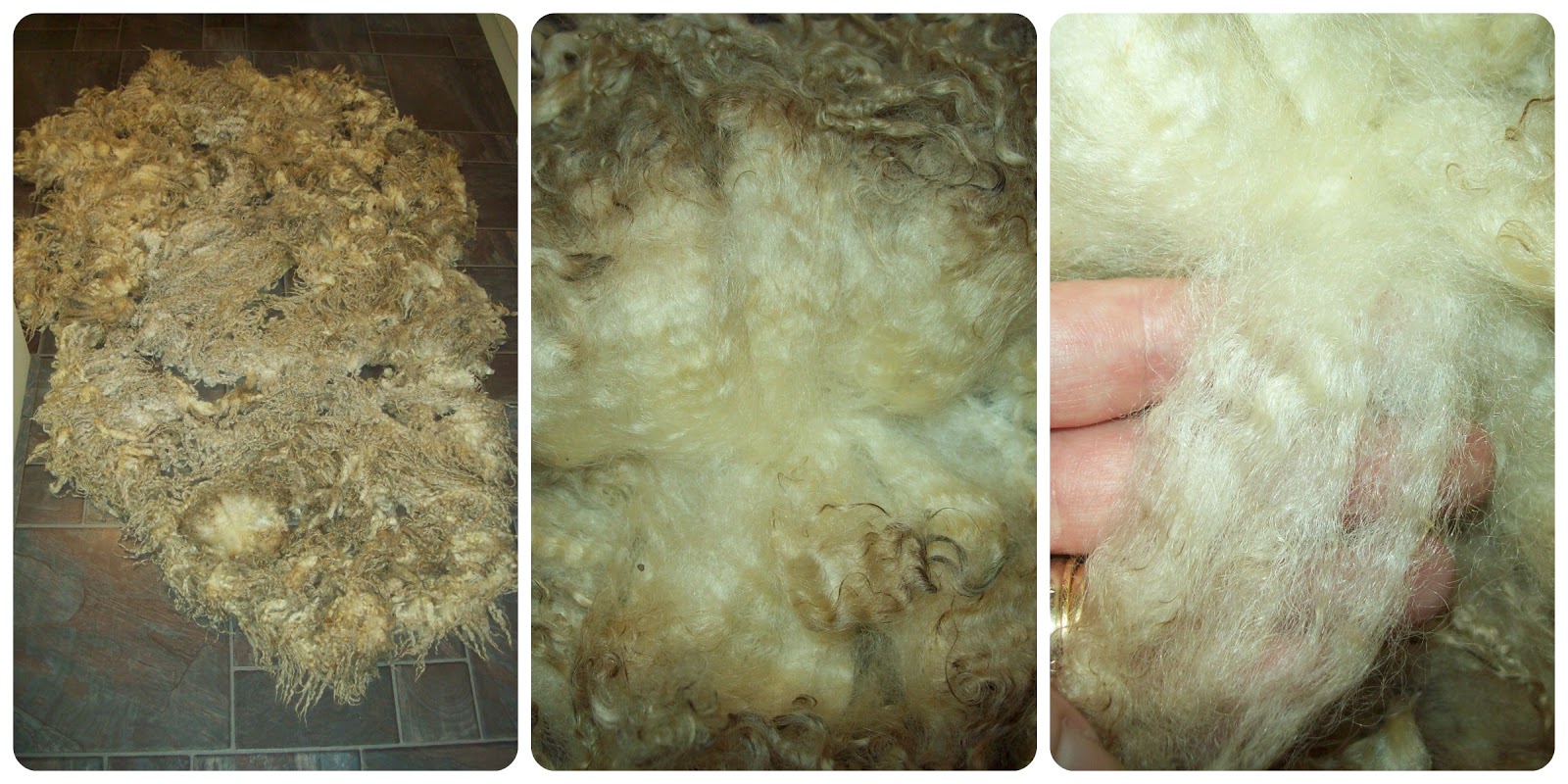
This was sheared on 26th May 2013, lovely in places but very dirty and was fairly heavy in surface VM. After I skirted it it weighs 1.1kg, photos were taken after skirting had taken place.
I separated the colours as best as I could into pile of black/brown, a pile of white and the last pile was a mixture of the colours that were too mingled to separate. I washed and dried the colours separately and was left with 729g of clean fleece, a loss of 371g of dirt and grease, broken down as follows: 86g white, 393g black/brown and 250g mixed colour.
The White Fleece
I combed the 86g of white fleece, which gave me approx 55g of hand combed top to spin. I decided to have a go at dyeing it with some ColourCraft All-In-One dyes that I had recently bought. I followed the instructions using 5g of Ultra Marine dye crystals in 1.5 litres of water to dye my hand combed top. Towards the end of the dyeing process I sprinkled 5ml of white vinegar over the top in the dye pot and left it for 15 minutes, as this is supposed to help the dye to be absorbed and I think this is what caused some areas to be darker than others. Learning by experimenting. Such fun!
I didn't blend the top, just spun it as it came. The finished skein was a 2ply double-knit weight yarn, 55g/85m which was used with other yarns in a scarf.
The Mixed Colours Fleece
I then took the 250g of mixed colour fleece and combed it, blending the colours as equally as I could as I went.
This gave me 128g of hand combed top, which I spun 2ply into a lovely double-knit weight grey yarn which I have called Storm Cloud and it is 128g/258m.
The Black Fleece
I combed this and 393g of fleece was soon reduced to 225g of hand-combed top. I then got an idea to make it colourful. Years ago, I bought a yarn sample and colour sample set from Colinette Yarns. These weren't any use to me any more as some of the yarns they no longer made and some of the colours had gone the same way and they had developed new yarns and colours. Plus the fact that I rarely buy yarn in these day, not now that I can make my own. The yarn sample wasn't really any use to me as there were only a few that were pure wool, and those were white or some other pale colour. The colour sample, however, was a completely different kettle of fish. Bright and colourful and most of the yarn samples on there were the pure wool ones.
I pulled off the lengths of yarn that I thought would be ideal for me to use, mostly samples of Colinette Graffiti, which is a thickish single with a finer 2ply yarn plied around it. I took these apart, laying the 2ply aside for a later use. I discovered that the thickish single had a thread running through the centre of it which was easy to pull on and remove and then I pre-drafted these lengths slightly.
I spun one plain black Jacob single and a second which was black Jacob with lengths of the de-constructed Colinette Graffiti inserted randomly. These two singles were then plied together to give me a double-knit weight yarn. One skein is 156g/280m and the other is 135g/238m and I have called this yarn "Remember, Remember the 5th of November".
So that is all of the fleece used up to make these fabulous skeins of yarn.
This was sheared on 26th May 2013, lovely in places but very dirty and was fairly heavy in surface VM. After I skirted it it weighs 1.1kg, photos were taken after skirting had taken place.
I separated the colours as best as I could into pile of black/brown, a pile of white and the last pile was a mixture of the colours that were too mingled to separate. I washed and dried the colours separately and was left with 729g of clean fleece, a loss of 371g of dirt and grease, broken down as follows: 86g white, 393g black/brown and 250g mixed colour.
The White Fleece
I combed the 86g of white fleece, which gave me approx 55g of hand combed top to spin. I decided to have a go at dyeing it with some ColourCraft All-In-One dyes that I had recently bought. I followed the instructions using 5g of Ultra Marine dye crystals in 1.5 litres of water to dye my hand combed top. Towards the end of the dyeing process I sprinkled 5ml of white vinegar over the top in the dye pot and left it for 15 minutes, as this is supposed to help the dye to be absorbed and I think this is what caused some areas to be darker than others. Learning by experimenting. Such fun!
I didn't blend the top, just spun it as it came. The finished skein was a 2ply double-knit weight yarn, 55g/85m which was used with other yarns in a scarf.
The Mixed Colours Fleece
I then took the 250g of mixed colour fleece and combed it, blending the colours as equally as I could as I went.
This gave me 128g of hand combed top, which I spun 2ply into a lovely double-knit weight grey yarn which I have called Storm Cloud and it is 128g/258m.
The Black Fleece
I combed this and 393g of fleece was soon reduced to 225g of hand-combed top. I then got an idea to make it colourful. Years ago, I bought a yarn sample and colour sample set from Colinette Yarns. These weren't any use to me any more as some of the yarns they no longer made and some of the colours had gone the same way and they had developed new yarns and colours. Plus the fact that I rarely buy yarn in these day, not now that I can make my own. The yarn sample wasn't really any use to me as there were only a few that were pure wool, and those were white or some other pale colour. The colour sample, however, was a completely different kettle of fish. Bright and colourful and most of the yarn samples on there were the pure wool ones.
I pulled off the lengths of yarn that I thought would be ideal for me to use, mostly samples of Colinette Graffiti, which is a thickish single with a finer 2ply yarn plied around it. I took these apart, laying the 2ply aside for a later use. I discovered that the thickish single had a thread running through the centre of it which was easy to pull on and remove and then I pre-drafted these lengths slightly.
I spun one plain black Jacob single and a second which was black Jacob with lengths of the de-constructed Colinette Graffiti inserted randomly. These two singles were then plied together to give me a double-knit weight yarn. One skein is 156g/280m and the other is 135g/238m and I have called this yarn "Remember, Remember the 5th of November".
So that is all of the fleece used up to make these fabulous skeins of yarn.
Friday, 11 October 2013
Angelo - the Cotswold ram lamb - Part I
Through one of the fleece/spinning forums that I am part of, a very nice farmer has been welcomed to our "flock" so that he can sell his award winning fleece direct to hand-spinners. He keeps and shows a beautiful flock of Cotswold Sheep. These are one of the Longwool breeds and he shows his sheep and then after the fleece have been sheared, he shows those too then at the end of the show season he sells the fleece to hand-spinners. I put my name down for one and it has arrived. WOW, its beautiful!!!
This is Angelo, the ram lamb that the fleece has come from and a photo of the fleece that Rob sent to me before I purchased it. Angelo's grandfather won the title of Champion Ram at the Royal Show.
Rob looks after his sheep extremely well and spends hours picking out all the VM from his fleeces so that they are in pristine condition for showing. This fact, and the fact that his fleece are out-of-this-world, make his fleece highly desirable and there is currently a waiting list, which at the time of writing is about 2 or 3 years long, meaning that is the length of time you have to wait to get your chance of getting your hands on one of these.
The starting weight of this fleece is 1950g but as you can see, its not white and its full of gorgeous lanolin which is great for the sheep, the fleece and my hands but not so great for my hand combs. Nice long staple and lots of lustre. Can't wait to see the wonderful yarn that this will make.
There was a small amount of second cuts and rubbish weighing 96g, a very small amount given the size of the fleece and a pile of locks waiting to be washed looks fantastic.
Washing
I used my usual method of washing a fleece which is separating the locks from the whole fleece and using net laundry bags to soak the locks in hot soapy water, regular dishwashing detergent is fine. I usually use one that also has anti-bacterial qualities too. My fleece has 2 hot soapy soaks to remove dirt and grease, followed by 2 plain hot water soaks to remove any residue soap and also to remove any further dirt trapped in the locks. Important: always run the hot water first, then add the soap and carefully/gently swirl the water. Do not shake your hands in the water, you do not want a bubble bath. Carefully lower the bag of fleece into the water and push down slowly and gently into the water. That is it, leave it alone for about 20 minutes, do not touch it or you will end up with a bag of felted mess. The hot water and soap will do its job perfectly well. When it comes to changing the water, you carefully lift one end of the bag over onto the other end (fold in half basically) and then lift the whole thing out and let the water run out before gently squeezing most of the excess water out, DO NOT WRING. Fill sink with fresh hot water and go again.
Just look at that water, and that is from the second hot soapy water soak.
Clean by comparison, or is it?
The locks on the left have been washed but the tips are still a bit mucky but these can be gently rubbed underneath the water and usually loosen up and shed their dirt. The locks on the right are in need of washing.
Lay out to dry, whoops, missed a bit of a dirty lock there, which was soon rectified.
Just ignore our mess in the background, my hanging drier is out in the utility room/storage area for some of the gardening bits and pieces and recyclable boxes etc. Look at how clean it looks close up now.
This is Angelo, the ram lamb that the fleece has come from and a photo of the fleece that Rob sent to me before I purchased it. Angelo's grandfather won the title of Champion Ram at the Royal Show.
Rob looks after his sheep extremely well and spends hours picking out all the VM from his fleeces so that they are in pristine condition for showing. This fact, and the fact that his fleece are out-of-this-world, make his fleece highly desirable and there is currently a waiting list, which at the time of writing is about 2 or 3 years long, meaning that is the length of time you have to wait to get your chance of getting your hands on one of these.
The starting weight of this fleece is 1950g but as you can see, its not white and its full of gorgeous lanolin which is great for the sheep, the fleece and my hands but not so great for my hand combs. Nice long staple and lots of lustre. Can't wait to see the wonderful yarn that this will make.
There was a small amount of second cuts and rubbish weighing 96g, a very small amount given the size of the fleece and a pile of locks waiting to be washed looks fantastic.
Washing
I used my usual method of washing a fleece which is separating the locks from the whole fleece and using net laundry bags to soak the locks in hot soapy water, regular dishwashing detergent is fine. I usually use one that also has anti-bacterial qualities too. My fleece has 2 hot soapy soaks to remove dirt and grease, followed by 2 plain hot water soaks to remove any residue soap and also to remove any further dirt trapped in the locks. Important: always run the hot water first, then add the soap and carefully/gently swirl the water. Do not shake your hands in the water, you do not want a bubble bath. Carefully lower the bag of fleece into the water and push down slowly and gently into the water. That is it, leave it alone for about 20 minutes, do not touch it or you will end up with a bag of felted mess. The hot water and soap will do its job perfectly well. When it comes to changing the water, you carefully lift one end of the bag over onto the other end (fold in half basically) and then lift the whole thing out and let the water run out before gently squeezing most of the excess water out, DO NOT WRING. Fill sink with fresh hot water and go again.
Just look at that water, and that is from the second hot soapy water soak.
Clean by comparison, or is it?
The locks on the left have been washed but the tips are still a bit mucky but these can be gently rubbed underneath the water and usually loosen up and shed their dirt. The locks on the right are in need of washing.
Lay out to dry, whoops, missed a bit of a dirty lock there, which was soon rectified.
Just ignore our mess in the background, my hanging drier is out in the utility room/storage area for some of the gardening bits and pieces and recyclable boxes etc. Look at how clean it looks close up now.
Subscribe to:
Posts (Atom)