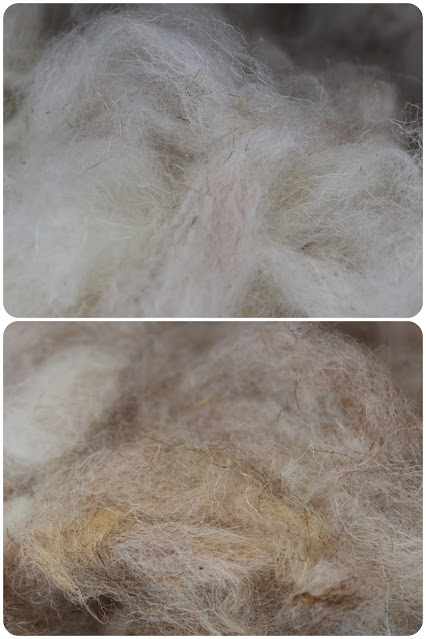
Tuesday, 23 February 2021

Blending the Suri Alpaca and Merino

I can't believe it has been a whole year since I combed the Suri alpaca and made a kind of a gradient with it.  I bought the merino I intended to buy to blend with it ages ago now but just procrastinated about it ever since but today is the day that I put my big girly pants on and deal with it.

The plan is to blend an equal amount of merino, made up of however many colours and blends of colours necessary to make it work, with an equal amount of Suri alpaca.  I will be making a 2-ply yarn so everything needs to be split into two equal amounts as well.  I will be using my trusty strong cardboard tube (was previously the inner off a large roll of Christmas wrapping paper, potentially a 25m roll which would need a sturdy inner, as opposed to a smaller 5m roll which usually just has a thin piece of card rolled in with the paper towards the centre of the roll).  I have made "stop ends" and a centre divider for roll by cutting large circles from a cardboard box and making a hole in the middle.  The fibre for each ply should fit on either side of the centre divider.

Using my trust blending hackle I started by taking the darkest alpaca fibre and the darkest of the merino and blending them.  The next one was a mix of the darkest alpaca fibre, the darkest merino and the next lighter shade of the merino.  I made my way through the alpaca and the merino, matching the colours/shades as best as I could, using a blend of 4 shades to where necessary to make a smoother transition on the gradient.

Top row: Merino shades Pearl and Chocolate.  Middle row: Merino shades Mink and Amber. 
Bottom row: The Suri Alpaca gradient and Merino shade Hazelnut

It took me a few hours of figuring out, deciding what to do, weighing out, a few "don't touch that", "don't move that" to the family, blending and dizzing off but I got there in the end.


There was one fibre nest on each side that I thought stood out a little too much from the others, maybe I put a little too much amber Merino in them, it seemed quite "yellow" compared to the others, but on examination its just that its not quite as blended in so should resolve at the spinning process.  Fingers crossed.

Saturday, 20 February 2021

Badger Face Welsh Mountain Sheep - Torddu

The Badger Face Welsh Mountain Sheep, hmmm yes, there are, in fact, two different breeds, the Torddu (black belly) and the Torwen (white belly) and yet in the books that I have about sheep breeds and their fleece the two are always clumped together and talked about as if they are just different colours of the same breed.  From information provided by the farmer from whom I got my fleece and who answered my question about breeding and colour inheritance they are not the same breed and have to be bred Torddu to Torddu and Torwen to Torwen.  The fact that they are separate breeds has now been recognised by the Rare Breeds Survival Trust who have now separated out the numbers of each breed and they are in two different categories.  I will do my best to try and separate out the information about each of the breeds which are usually talked about as one breed and I am writing two separate posts about them.
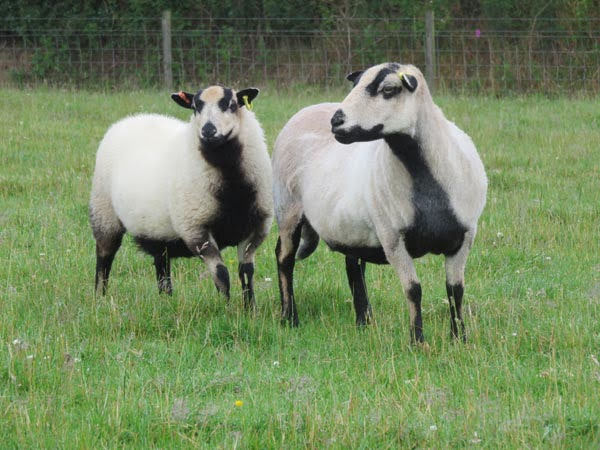

The Badger Face Welsh Mountain Sheep, according to the British Wool Marketing Board, was established in the UK during the 1st century but they don't specify which one they are referring to.  This post is specifically about the Torddu, which is pronounced Tor-thee, and this is a predominantly white sheep with black markings.  Only the rams have horns.  It has black stripes above the eyes and a black stripe running from the chin, down its front, under the belly and all the way to the tail.  The rest of the fleece is usually white but can be grey or light brown.

At the time of writing, the Badger Face Welsh Mountain - Torddu, also known as the Torddu Badgerface Welsh is in the "Other UK Native Breeds" category, according to the Rare Breeds Survival Trust, which means there are over 3000 registered breeding ewes of this breed.

They are usually found in mid-wales but there are small specialist flocks in other parts of the UK too.

Because they are primarily raised for meat, the fleece is usually secondary and most often little attention is given to it.  Kemp may be present and many take this as a theoretical indicator to the hardiness of the sheep whilst others find it undesirable.  Generally the fleece weigh 1.5 to 2kg with a 3-4 inch (7-10cm) staple length, I presume this is for both breeds from what I can find out.

Because the quality of the fleece can be so varied I will not comment generally on how best to prepare the fleece because that really does depend on what type of fleece you have and how much work you want to put in in preparing it and what type of yarn you hope to get from it.  It is not a fleece that should be prepared by the inexperienced, that is for sure! 


I originally bought this breed in as a 50g bag of washed fleece, it was all that the seller had left so I could only get one bag, and once I had combed it and got 25g of hand combed top I realised there was probably nowhere near enough for the project so that has been left to one side and then I have bought this breed in as a full fleece from a farm in Okehampton, Devon, that specialises in keeping and raising a handful of different rare breeds of sheep, both Badger Face Welsh Mountain - Torddu and Torwen, Whiteface Dartmoor and Herdwick.  They also raise Red Ruby Devon cattle, Berkshire Pigs, Aylesbury and Shetland Ducks, Black Orpington chickens and Pilgrim Geese.

My fleece came in at just over 1.5kg, including the bag it was wrapped in and I removed a few bits, like the small amount of black belly fibres and I have 1400g to sort further and wash.  It's very kempy and has an area of dark, almost grey fibres and several "marked" areas and I have pulled these areas off and have washed them separately to the rest of the fleece.
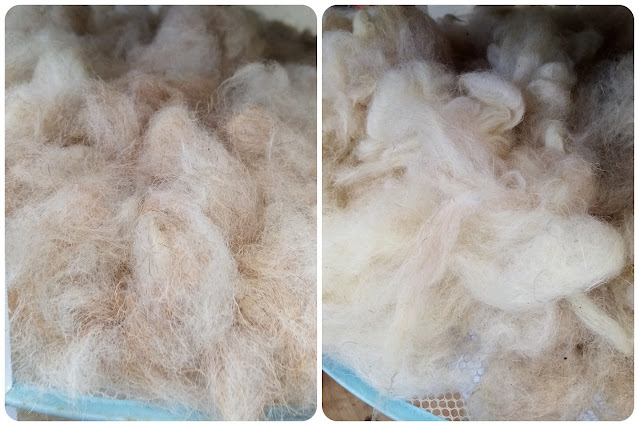

Shows the variety of fleece type within the same fleece

And a close up of those two different types

Now that it's dry the weight is down to 913g. So, how will I handle this?  Quite simply, my usual method of preparation, my Valkyrie Extrafine Wool Combs.  There is kemp of pretty much every colour imaginable in this fleece along with some coarse hair but I can also see some very fine wool.  Its the fine wool that I am after. 
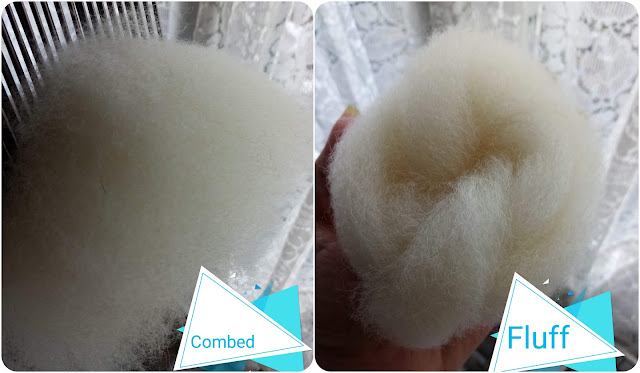

These 4 photos are of the same small amount of fleece, first on the combs, then what was removed, the same fleece combed and then once I had dizzed it off the combs


So, now that it is all combed I have 199g of nice clean white hand combed top and 67g of nice clean but colourful top.  The colourful top and the original 25g of hand combed top will have to be dyed and used together in another project.


My finished yarn is really nice and soft to the touch of the hand and is a nice white and I have a total of 197g/512m of sport weight.  My knitted piece for the project took 31g/79m so I have a nice amount left to do whatever I want with.


Friday, 19 February 2021

Combing the last of the Llanwenog

It's been well over 2 years, nearly 3 in fact, since I dyed the Llanwenog fleece and I have finally gotten around to combing the rust coloured part.  It has taken me a couple of days to get through the bag full of dyed fleece but I now have 216g of hand combed fibre.  I plan to now figure out what I want to blend with it to jazz it up a bit, as its not a particularly pretty colour.


Monday, 1 February 2021

Greyface Dartmoor Sheep

The Greyface Dartmoor, one of the English Longwool breeds of sheep, was developed and lives on Dartmoor, a National Park in Devon in the Southwest of England.  They are one of two breeds of sheep who live there, the other being the Whiteface Dartmoor.  Whilst they are similar in many ways, they are two completely different breeds of sheep.  According to the British Wool Marketing Board the breed was established in the UK during the 17th century.


The Greyface Dartmoor sheep, at the time of writing, is in the Rare Breeds Survival Trust Category 5: Minority (1500-3000) registered breeding ewes.  

They are a relatively old breed, developed in the 1800's by combining Leicester Longwool, Lincoln Longwool and the now-extinct Notts with possibly some Cheviot and Southdown bloodlines.  The name of Greyface actually refers to the greyish-black mottled colour around their noses.  

The Greyface Dartmoor is a small-medium build sheep with a whiteface that is spotted or mottled, greyish-black nose and neither sexes have horns.  The face is fringed with white wool. 

They produce a good size fleece that weighs 5.5 to 8kg in weight and can be up to as much as 15kg for a large ram.  The staple length can be anything from 6 inches up to about 12 inches long (15-30cm). The fleece is long, strong, curly and lustrous but if you're looking for softness, turn around and run a mile because softness does not belong on a sheep that lives in some of the harshest and most extreme weather conditions of the UK. 

This fleece can be picked and flicked or combed but make sure you tease the locks apart and open before you mount them onto the combs and do not overload the combs.  You will need to take very long strokes and keep your hands very far apart due to sheer length of the staples.  The fibres are so long and coarse that if you tug too hard on them you can actually cut your hands on it.  Its very slippery too and will both clump and drift apart if you cling to it.

Yarns spun from Greyface Dartmoor fleece are definitely suited to hardwearing textiles such as blankets, rugs and carpets.  The locks can be used unspun but woven into a rug too to make a fleece style rug.


I have bought this breed in as pre-prepared roving and it is definitely very coarse, as you can see from the photos.


My finished yarn or maybe I should call it rope is of coarse quality to the touch of the hand and you can see and feel the prickly hair sticking out all over the place and I have 91g/155m.  My knitted piece for the project took 42g/72m and what I have left I will use as garden twine.  To knit with it was really awkward and very uncomfortable on the hands and as you can see, there is very little stitch definition. 


Thursday, 28 January 2021

Beulah Speckled Face Sheep

The Beulah Speckled Face sheep is also known as the Eppynt Hill and Beulah Speckled Face sheep and is named after the hilly area in south-central Wales where these sheep originate and are still kept today.  They are fairly common in Wales but not very well known outside of Wales.  The actual origins of the breed are a mystery.  It might be a true native breed as there is no mention of cross breeding in any literature.  According to the British Wool Marketing Board the breed was established in the UK during the 20th century.

There are not many decent detailed photos of these sheep available on the Internet without having to pay extortionate amounts of money for them, but that is not an argument I want to get into here.

The Beulah Speckled Face sheep, at the time of writing, is in the "Other UK Native Breeds" category, according to the Rare Breeds Survival Trust.  This means that there are over 3000 sheep of this breed registered with the relevant breed society.

The Beulah Speckled Face is bigger than a true mountain sheep.  It has long head, speckled face and legs, which are free from wool. Ewes and most rams don't have horns.  The ewes are good mothers and produce good milk and are often crossed with downland rams to produce early prime lambs.

They produce a medium size fleece of 1.5 to 2.5 kg that can vary greatly from fine to coarse.  Finer fleece are great for knitwear and coarse fleece are best left for carpets and household textiles that need to withstand a lot of wear.  The larger, heavier fleece tend to the be at the coarse end of the range.  The staple length is generally 3-5 inches (7.5-12.5cm).  The fleece is white and shouldn't have any dark fibres. 

This fleece can be carded and spun woollen style or combed and spun worsted style.  It is generally quite a white wool, certainly brighter and less creamy than others that I have tried so far.  I've not dyed any myself but information available tells me that you get clean colours when you dye it.  

Yarns spun from fine fleece are perfect for everyday items and if you are spinning a coarse fleece then those yarns are best for household textiles.  


I bought this breed in as 530g of pre-washed fleece, which was the only option available to me at the time.  When it arrived I could see it was full of dark coloured kemp and fine dark hairs, non of which should be there, but seeing as I would be combing it I hoped that the majority would be removed during the preparation process.


After I had combed it I was left with 339g of hand combed top, most of the dark kemp and very short hairs had been removed but there was still a fair amount of long dark hairs that were ruining it so armed with a pair of tweezers and good light I sat and picked out as many as I could and this left with me 318g of top to spin.  There are still some hairs in there and some dirt and grease too, it's not been washed to my standard.


My finished yarn is quite soft to the touch of the hand and a nice clean white.  I lost a number of grams of weight during the washing process when the rest of the dirt and grease came out.  I have a total of 299g/795m.  My knitted piece for the project took 33g/94m so I have some left to do whatever with.


Thursday, 14 January 2021

Llanwenog Sheep

The next breed of sheep is the Llanwenog, a welsh breed of sheep belonging to the Welsh Hill and Mountain family.  Developed in the late 1800's from the now-extinct Llanllwni (the local black-faced sheep of the western coastal counties of Wales and named for the mountain they lived on), Shropshires, Welsh Mountain and Clun Forest breeds.  According to the British Wool Marketing Board the breed was established in the UK during the 19th century.


The Llanwenog sheep, at the time of writing, is in the Rare Breeds Survival Trust Category 5: Minority (1500-3000) registered breeding ewes. They are a prolific breed raised primarily for meat and are usually found in mid-west Wales but there are specialist flocks around the UK and the breed association was formed in 1957. 

The Llanwenog is a medium build sheep with a blackface and black legs and a distinctive tuft of wool on its forehead between its short thin ears.  Neither sexes have horns

They produce a medium size white fleece of around 2 - 2.5kg and the staple length is 2 to 4.5 inches (5 to 11.5cm).  The shorter fibres in the fleece can be carded but this is a fleece that is best combed and spun worsted to show off its lustre, shine and sleek qualities.  It can be spun from opened locks.  This fleece takes dye well.

Yarns spun from Llanwenog fleece are quite soft with good stitch definition and can be used for whatever you want to make.  


I bought this breed in as a full fleece back in July 2018 from a farmer in Wales, long before I decided to create a British Breeds Project or write about every British Breed.  At the time, I washed the fleece and split it into four, dyeing three parts different colours and, luckily for me, I left one part white and this is what I will use for my Breed Project. My skirted fleece arrived weighing 1.7kg and after I had removed any other undesirable bits and second cuts, washed and dried it, it weighed 1.33kg


I had 262g of washed white fleece which, once combed, became 150g of hand combed top


I lost 10g somewhere because my skeins total 140g/418m of double knit weight yarn


My finished yarn is fairly soft to the touch of the hand is a nice warm white.  My knitted piece for the project only took 16g/48m so I have plenty left to do whatever with.

The "w" in the middle looks a bit weird but it is there and is perfectly formed


Sunday, 3 January 2021

Lonk Sheep

The origin of the sheep's name is a bit of a mystery.  Some believe it derives from the words long or lanky, the sheep are quite tall, whilst others believe it derives from the word Lancashire, the county from which this breed hails.  According to the British Wool Marketing Board the breed was established in the UK during the 12th century.


The Lonk sheep, at the time of writing, is in the Rare Breeds Survival Trust Category 5: Minority (1500-3000) breeding ewes and it has a minus sign next to it which means it has seen more than a 5% decrease in numbers since the previous report. 

Lonk are concentrated to the Pennines in Lancashire with one flock being able to be traced by to 1740, but there are some flocks of these sheep now in Yorkshire and Derbyshire.  They are one of the largest native British Hill breeds and can survive on poor grazing and in bleak conditions so are usually found on the moors and uplands of the Pennines.  

Similar in looks to the Derbyshire Gritstone but Lonks are larger and both sexes have horns whereas the Derbyshire Gritstones have no horns. Their faces and legs are black and white and free of wool, which is white.

They produce a good sized fleece of 2-3kg with blocky staples with well developed but disorganised crimp. There may be some black hairs in the fleece and sometimes there can be a small amount of kemp but is generally kemp free.  The books that I have describe the fleece as rough and robust but not harsh and that its main use is for carpets but my finished yarn is really nice.

This fleece can be prepared and spun however you want to work it and combing and spinning worsted style will minimise any prickle factor.  It is a warm white, not a brilliant white, but definitely not a creamy or yellow white like some other breeds.  I've not dyed mine but apparently it takes dye clearly but with a soft effect.


I have bought this breed in as pre-prepared roving and my sample had quite a few black hairs in it along with varying amounts of white kemp, which fell out easily during spinning, plying, snapping and shaking to leave me with a lovely soft yarn.


My finished yarn is of medium to soft quality to the touch of the hand and is fairly white with a warm glow, although it has a matte finish and is 100g/338m.  My knitted piece for the project only took 5g/17m so I have plenty left to do whatever with.